Automotive manufacturers face growing pressure to track every component through the production chain. Regulators, OEMs, and end customers all demand it. That is why the SPM laser marking machine for automotive has become essential equipment on modern production floors. It handles 2D 3D job marking with precision and speed that manual processes cannot match. Furthermore, it delivers consistent automotive marking across complex, curved, and high-volume component runs — making it the backbone of smart traceability systems.
Traditional marking methods — inkjet printing, mechanical engraving, and label application — cannot meet today’s demands. They produce marks that fade, smear, or detach. As a result, traceability breaks down at critical points in the supply chain.
SPM laser marking eliminates these problems. The laser engraves directly into the material surface. The mark is permanent, high-contrast, and machine-readable. It survives heat, chemical exposure, and mechanical stress — conditions that automotive components routinely face.
Additionally, SPM systems integrate with automated production lines. They receive component data, generate the correct mark, and complete the operation without human intervention. This makes them central to Industry 4.0 traceability workflows.
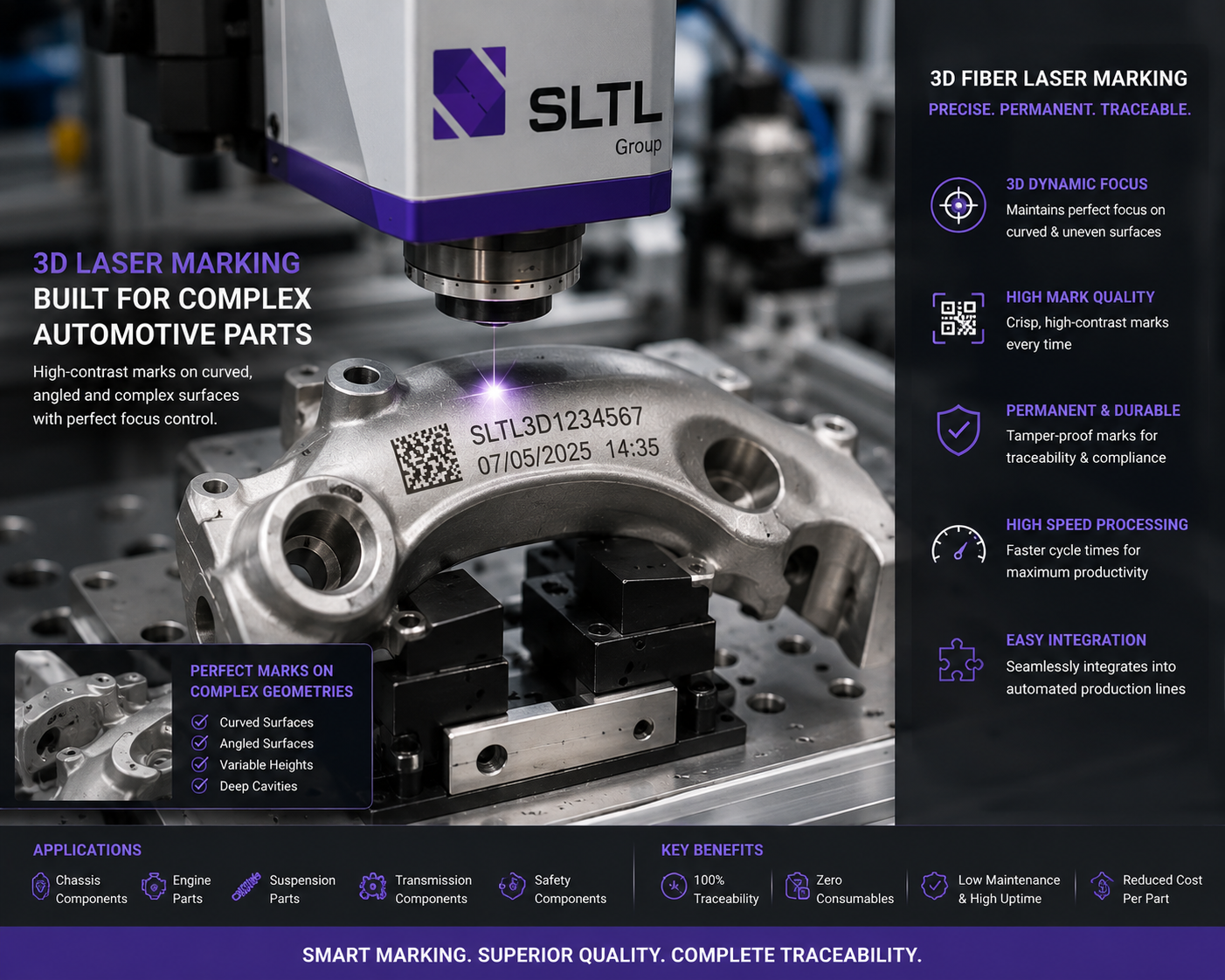
Moreover, modern SPM laser marking machines handle both flat and curved surfaces. 3D marking capability allows the beam to follow complex component geometries — such as engine blocks, pistons, and curved chassis members — without repositioning the part.
SLTL Group manufactures a comprehensive range of SPM laser marking systems for automotive applications. From compact diode models to high-power fiber and CO2 laser platforms, each machine is engineered for a specific production environment and marking requirement.
Why an SPM Laser Marking Machine for Automotive Manufacturing Matters
Automotive traceability is no longer optional. Regulatory standards such as IATF 16949 and customer-mandated tracking requirements demand permanent, scannable identification on every critical component. An SPM laser marking machine for automotive production meets this requirement directly.
Automated Traceability for Smart Manufacturing
Traceability failures create costly recalls and compliance violations. Laser marking removes the weak points. Each component receives a permanent, machine-readable mark — a QR code, data matrix, serial number, or part identifier — at the point of manufacture.
Smart manufacturing platforms scan these marks throughout the production and assembly process. As a result, manufacturers maintain a complete digital record of every component from raw material to final vehicle assembly.
High-Contrast Marking for Automotive Components
Automotive components operate in demanding environments. Engine heat, vibration, oil exposure, and mechanical wear degrade conventional marks quickly. Laser marking changes this.
The laser engraves into the metal surface itself. There is no ink to fade, no label to detach. Consequently, marks remain readable throughout the entire component lifecycle — even after years of service in harsh operating conditions.
- Permanent identification that survives automotive operating conditions
- High-contrast marks readable by automated vision systems
- Elimination of manual marking errors and human-dependent quality variation
- Faster cycle times through integrated automated marking workflows
- Seamless compatibility with MES, ERP, and traceability software platforms
Key Features to Look for in an SPM Laser Marking Machine for Automotive Applications
Selecting the right SPM laser marking machine requires matching machine capability to your specific production requirements. Several core features define a high-performance automotive marking system.
2D and 3D Marking Capability
Flat-surface 2D marking handles sheets, plates, and machined flat faces. However, automotive production frequently requires marking on curved surfaces — valve bodies, connecting rods, bearing housings, and tubular assemblies.
3D marking capability uses dynamic focus adjustment to follow curved geometries. Therefore, the beam maintains consistent focus across the entire mark area — even on complex contoured surfaces.
Smart Automation and Software Integration
Modern SPM laser marking machines connect directly with production management systems. They receive component-specific data — serial numbers, batch codes, production dates — and apply the correct mark automatically.
Additionally, vision-based alignment systems locate the component and position the marking field precisely. This eliminates setup time and ensures mark placement accuracy across high-volume production runs.
Precision Marking on Curved Automotive Parts
Rotary attachments allow cylindrical components to be marked around their circumference. This is essential for shafts, pins, fasteners, and tube components where flat-surface access is not possible.
Smart fixture integration holds components in precise positions. As a result, mark location consistency is maintained across large production batches without operator adjustment.
- 2D and 3D marking head options for flat and curved surface coverage
- Rotary attachment support for cylindrical automotive components
- High-contrast fiber laser output for deep engraving and surface marking
- Vision-based component alignment for automated mark positioning
- PLC, SCADA, and MES system integration for smart factory operation
- Variable power and speed settings for multi-material compatibility
- Compact enclosed designs for integration into automated production cells
How 2D and 3D Job Marking Improves Automotive Manufacturing Efficiency
Laser marking directly improves production efficiency at multiple levels. Faster marking speeds reduce bottlenecks. Automated workflows eliminate manual handling steps. And permanent, scannable marks reduce rework and inspection costs.
High-Speed Industrial Laser Marking Workflows
SPM laser marking machines complete marking cycles in seconds. High-speed galvo scanning heads position the beam across complex mark patterns almost instantaneously. Therefore, cycle times per component are minimal — even for dense data matrix codes and multi-line text.
In high-volume automotive production environments, this speed translates directly into throughput gains. A single marking station can keep pace with fast assembly lines without becoming a bottleneck.
Common 2D and 3D marking applications in automotive manufacturing:
- Permanent serial number engraving on engine and powertrain components
- QR code and data matrix marking for automated traceability scanning
- Part number and batch code identification on structural assemblies
- Logo and brand marking on visible automotive components
- Date codes, revision marks, and compliance identifiers
- Deep marking on hardened steel for wear-resistant identification
Compatible materials for automotive SPM laser marking:
- Mild steel — structural frames, brackets, and body panels
- Stainless steel — exhaust systems, sensors, and fasteners
- Aluminum — engine housings, wheels, and lightweight assemblies
- High-strength automotive alloys — safety-critical structural parts
As automotive manufacturers adopt broader laser-based production technologies, traceability marking becomes part of a larger integrated workflow. For context on how laser technology is transforming automotive fabrication more broadly, our article Why Automotive Part Makers Are Moving from Conventional Cutting to Laser Cutting explains the industrial shift driving this transformation.
Additionally, piston ring marking, chassis identification, and tube component marking all benefit from SPM laser systems. These applications require consistent mark depth and contrast across high-volume runs — precisely what fiber and diode laser marking machines deliver.
Best SLTL SPM Laser Marking Machines for Automotive Production
SLTL Group engineers SPM laser marking systems for demanding industrial and automotive production environments. Their automotive traceability marking systems include seven specialized machines — each matched to a specific marking application, power requirement, and automation level.
REX — Diode Laser Marking System
REX is a compact diode laser system built for high-speed identification and traceability marking on automotive production lines.
- Diode laser technology for efficient, low-maintenance operation
- High-speed serial number and QR code marking capability
- Compact industrial footprint for easy production cell integration
- Reliable traceability marking on steel and aluminum components
Ideal REX applications:
- Serial number and part identification marking
- QR code and data matrix engraving for traceability
- Smart automotive component identification on fast production lines
Explore the REX system: REX Diode Laser Marking — SLTL Group
ELITE — Fiber Laser High-Contrast Marking System
ELITE is a fiber laser platform designed for high-contrast, permanent industrial marking where readability and durability are non-negotiable.
- Fiber laser output for superior marking contrast on metallic surfaces
- Precision engraving capability for fine-detail identification
- Permanent mark readability across harsh automotive operating environments
- Suitable for both surface marking and shallow engraving applications
Ideal ELITE applications:
- Automotive component identification and batch marking
- Fine-detail industrial engraving on precision machined parts
- Durable traceability marking for safety-critical automotive assemblies
Flexy — Movable Diode Laser Marking Machine
Flexy is a portable, movable diode laser marking system. It brings SPM marking capability to large assemblies and components that cannot be repositioned to a fixed marking station.
- Movable design for on-location marking of large automotive assemblies
- Flexible industrial operation across varied production environments
- Handles difficult-to-reach component faces and curved structures
- Portable marking capability for assembly and repair workflows
Ideal Flexy applications:
- Marking on large curved automotive components — chassis, frames, axles
- Flexible production setups requiring mobile marking stations
- Large industrial assembly marking without component repositioning
NEO — Fiber Laser Marking Machine (20–60W)
NEO is a multipurpose, high-power fiber laser marking system. It handles demanding automotive marking tasks — from deep engraving to high-speed automated production marking.
- Power range: 20–60W fiber laser for versatile industrial marking
- High-speed marking compatible with automated production lines
- Deep engraving capability for wear-resistant identification marks
- Smart manufacturing system integration via PLC and SCADA
Ideal NEO applications:
- High-volume automotive production line marking
- Deep industrial engraving on hardened steel and aluminum alloys
- Automated traceability marking integrated into production cells
View the NEO system: SPM Laser Marking Machine for Automotive Solutions — SLTL Group
Ultra — Fiber Laser Marking Machine (20–120W)
Ultra is SLTL’s highest-power fiber laser marking platform in this range. It delivers fine-detail precision at high output — suitable for demanding identification requirements across multiple material types.
- Power range: 20–120W for maximum marking flexibility
- Fine-detail engraving at high production speeds
- High readability output for dense data matrix codes and micro-text
- Compact industrial design for optimized floor space use
Ideal Ultra applications:
- Precision component marking on engine and powertrain parts
- Fine automotive identification on small, detailed machined components
- High-speed detailed engraving across mixed production batches
OptiFly — CO2 Laser Marking System
OptiFly is a CO2 laser marking machine optimized for plastic and non-metallic automotive components. It delivers clean, high-contrast marks on polymer surfaces at mass production speeds.
- CO2 laser technology for clean plastic and polymer surface marking
- Mass production compatible marking speeds
- High-contrast output on dark and light plastic substrates
- Industrial reliability for continuous production environments
Ideal OptiFly applications:
- Plastic automotive interior and exterior component marking
- Packaging and part identification labeling
- High-volume plastic traceability marking on automotive production lines
Carbon — CO2 Laser Marking System
Carbon is SLTL’s CO2 laser platform for non-metallic industrial marking and decorative branding applications in automotive and adjacent manufacturing environments.
- CO2 laser output for non-metal material marking applications
- Industrial engraving on rubber, composites, and technical polymers
- Decorative industrial branding with consistent quality output
- Smart factory integration support for automated production workflows
Ideal Carbon applications:
- Non-metal component marking — rubber seals, gaskets, composite panels
- Decorative automotive branding and logo engraving
- Automated marking in smart production cell environments
Smart Manufacturing Benefits of SPM Laser Marking Technology
SPM laser marking is not just a marking tool. It is a core component of smart automotive manufacturing infrastructure. Its integration with digital production systems defines how Industry 4.0 traceability functions on the factory floor.
Smart Automation in 2D and 3D Job Marking
SPM laser marking machines receive production data from MES or ERP systems. They generate the correct mark automatically — serial number, batch code, QR code — for each component. As a result, marking accuracy is 100% consistent across every production run.
Real-time marking verification systems confirm each mark immediately after engraving. Defective or unreadable marks trigger alerts before the component moves to the next production stage. Therefore, quality issues are caught early — reducing rework and scrap rates.
- Full MES, ERP, and SCADA system integration for data-driven marking
- Automated mark verification with vision system confirmation
- Production data logging for complete component traceability records
- Predictive maintenance alerts to minimize unplanned downtime
- Remote monitoring and parameter management for multi-line operations
- Scalable automation modules to grow with increasing production demand
Furthermore, SPM laser marking reduces operational costs compared to consumable-based marking systems. There are no inks, ribbons, or labels to purchase and manage. The laser source operates for tens of thousands of hours with minimal maintenance. Consequently, total cost of ownership is significantly lower over the machine’s production life.
For manufacturers building out complete laser-based production systems, SLTL’s automotive laser welding solutions complement marking workflows by providing precision joining capability for the same components that require traceability identification.
Applications of SPM Laser Marking in Automotive Manufacturing
SPM laser marking covers a broad range of automotive production requirements. Each application benefits from the precision, permanence, and automation capability that laser technology provides.
Core SPM Marking Applications in Automotive Production
- 2D job marking — flat surface serial number, QR code, and part ID engraving
- 3D job marking — curved surface identification on engine and chassis components
- Piston ring marking — permanent identification on high-wear engine components
- QR code engraving — scannable traceability codes on structural assemblies
- Serial number marking — production batch and unit identification
- Industrial logo engraving — brand identity on visible automotive parts
- Smart traceability integration — marks connected to MES production records
Integration with Laser Cutting and Welding Technologies
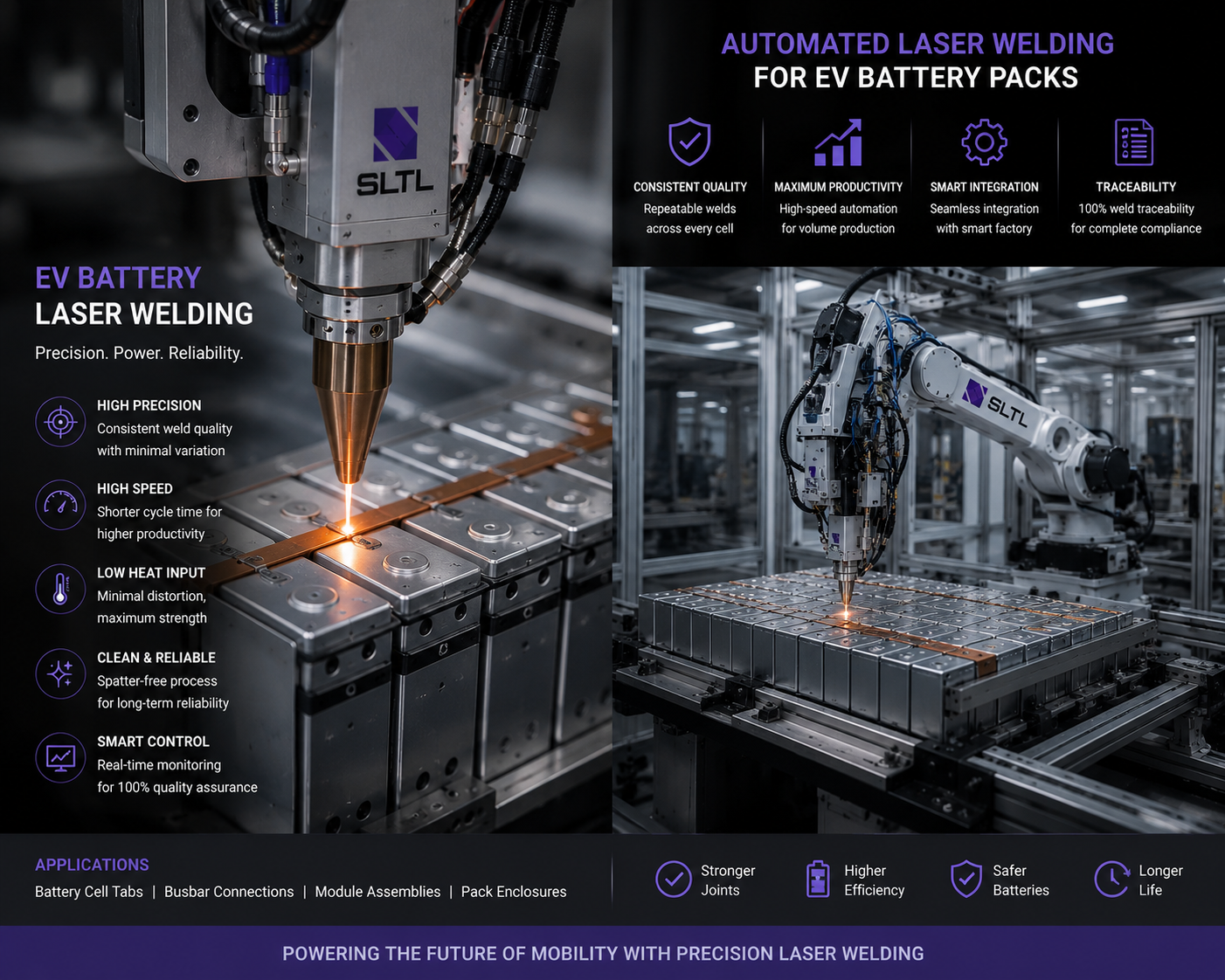
Laser marking works most effectively when it operates within an integrated laser production ecosystem. Laser cutting fabricates the component with precision.The Laser welding joins sub-assemblies to the required structural specification. And laser marking applies permanent traceability identification before the component moves to final assembly.
For example, a chassis crossmember is cut using a tube laser system. The welded joints are completed with a laser welding station. The finished assembly then passes through an SPM marking station where a data matrix code and serial number are engraved. The mark is scanned, and the component record is updated in the production management system automatically.
Similarly, airbag housings, composite structural panels, and tube-cut components all benefit from this integrated approach. Together, cutting, welding, and marking create a complete, automated, and traceable production chain.
Modernize Your Automotive Production with SLTL Laser Technology
Ready to integrate precision SPM laser marking into your automotive production line?
SLTL Group delivers advanced SPM laser marking, cutting, and welding systems for automotive OEM suppliers, component manufacturers, and smart factory operators. Whether you need 2D flat marking, 3D curved surface identification, or high-speed traceability on complex assemblies — SLTL has the right system.
Why choose SLTL laser marking technology?
- High-speed traceability marking — QR codes, serial numbers, data matrix
- Precision industrial marking on curved, complex automotive components
- Smart manufacturing integration — fully Industry 4.0 compatible
- Reduced operational costs — no consumables, low maintenance
- Improved production efficiency through automated marking workflows
- Automated inspection compatibility with vision-based mark verification
- Complete laser ecosystem — cutting, welding, and marking from one supplier
Contact SLTL Group today to discuss your automotive marking requirements and find the right SPM laser marking system for your production environment.
Explore our range: SLTL Laser Marking Machines | SLTL Laser Cutting Systems | SLTL Laser Welding Solutions
Conclusion
Automotive traceability requirements are only growing stricter. Production speeds are increasing. And the components being marked are becoming more geometrically complex. Manual and conventional marking systems cannot keep pace with these demands.
An SPM laser marking machine for automotive production solves all of these challenges simultaneously. It delivers permanent, high-contrast marks on flat and curved surfaces. It integrates with smart manufacturing systems. And it operates at the speeds that modern automotive production lines require.
SLTL’s REX, ELITE, Flexy, NEO, Ultra, OptiFly, and Carbon marking systems give automotive manufacturers the flexibility to mark any component — on any surface — with any marking requirement. Combined with SLTL’s laser cutting and welding technologies, manufacturers gain a complete, integrated fabrication and traceability ecosystem.
For automotive OEM suppliers, component manufacturers, and smart factory operators ready to upgrade their traceability infrastructure, SLTL laser technology delivers the precision, reliability, and automation capability that modern production demands.
Frequently Asked Questions (FAQs)
1. What is the difference between 2D and 3D SPM laser marking for automotive parts?
2D marking operates on flat surfaces — plates, machined faces, and sheet metal components. 3D marking uses dynamic focus adjustment to follow curved and contoured surfaces — such as engine housings, piston rings, and curved chassis members — maintaining consistent mark quality across the full geometry.
2. Can an SPM laser marking machine integrate with automotive production line automation?
Yes. Modern SLTL SPM laser marking machines connect directly with PLC, SCADA, MES, and ERP systems. They receive component-specific marking data automatically and complete the marking operation without manual input. Additionally, vision-based verification systems confirm mark quality immediately after engraving.
3. How fast is SPM laser marking on automotive production lines?
Marking speed depends on machine power, mark complexity, and material type. High-power fiber laser systems such as the NEO and Ultra complete serial number and QR code marking cycles in under two seconds per component. This speed is sufficient to keep pace with fast automotive assembly line throughput.
4. Which SLTL machine handles curved automotive component marking best?
The SLTL Flexy (movable diode laser) and NEO/Ultra (fiber laser with 3D marking option) are best suited for curved automotive components. Additionally, the Flexy’s portable design allows it to mark large assemblies — such as chassis frames and axles — without repositioning the component.
5. What traceability standards do SLTL SPM laser marking machines support?
SLTL laser marking machines produce permanent, machine-readable marks — data matrix codes, QR codes, and linear barcodes — that meet automotive traceability requirements including IATF 16949, ISO/IEC 15415 (2D code quality), and customer-specific OEM marking specifications. Marks are scannable by automated vision systems throughout the supply chain.