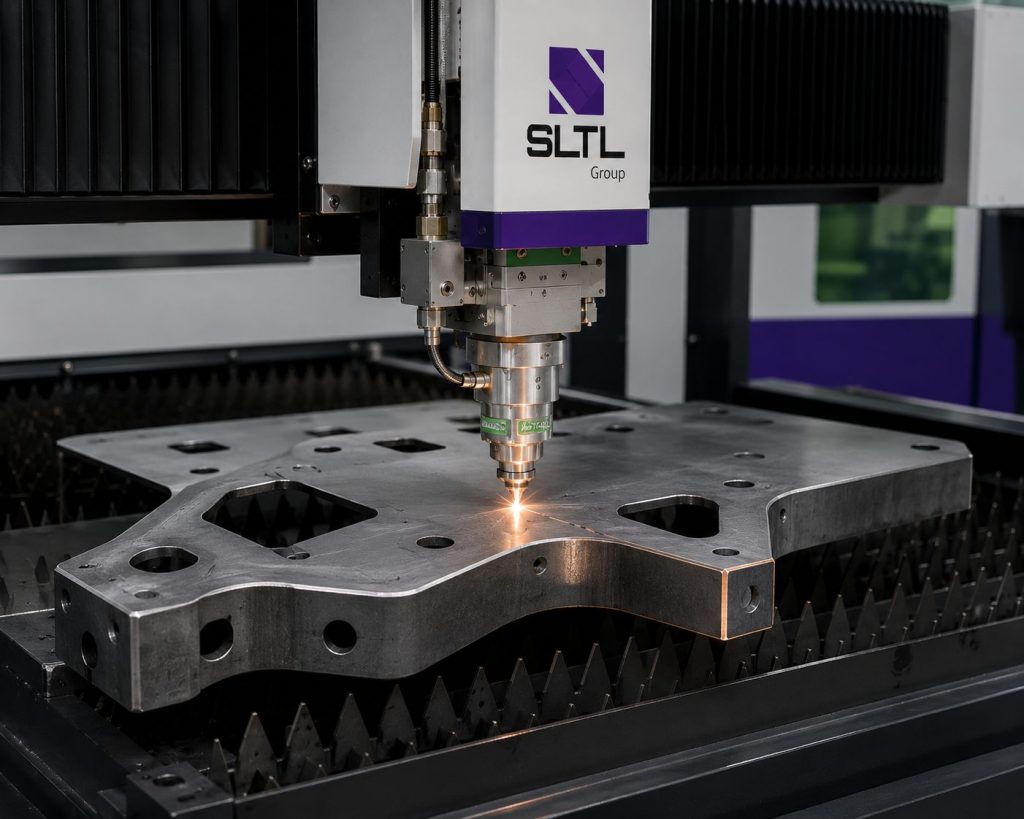
Buying a laser cutting machine is not the hard part. Buying the right one is. In automotive manufacturing, laser cutting machine power selection is one of the most consequential decisions a production engineer or procurement team makes. Choose too little power and the machine becomes the production bottleneck — unable to cut thicker structural sections at the speed the line demands. Choose too much and capital investment and energy costs increase without delivering proportional value.
Getting this decision right requires understanding how fiber laser power interacts with material thickness, material type, and production volume across both sheet and tube cutting applications. This blog provides a practical guide to that decision — covering the key variables, the power ranges that suit different automotive applications, and the SLTL systems built to match specific production requirements.
Why Laser Cutting Machine Power Selection Matters in Automotive Manufacturing
Power selection is not a specification on a datasheet — it is a production decision. The wrong power level affects every part that machine produces, for the entire operational life of the system.
Impact on Production Speed
Laser cutting speed scales with power on thicker materials. A 3 kW fiber laser cuts 6 mm mild steel at a significantly lower speed than a 12 kW system on the same material. For a chassis bracket line running 500 parts per shift, that speed difference is the gap between hitting production targets and falling short.
However, speed is not simply a function of power alone. Beam quality, assist gas pressure, and cutting head design all contribute. Therefore, laser cutting machine power selection must be evaluated in the context of the full system specification — not just the watt rating.
Impact on Cut Quality and Edge Finishing
Higher power does not always mean better quality. On thin automotive sheet (0.8–2 mm), very high laser power at low speed can produce excess heat input — widening the HAZ, increasing oxidation on the cut edge, and causing burn-through on thin sections.
The optimal power level for each material and thickness produces the highest cut quality at the fastest speed. Consequently, power selection is about matching the machine’s capability to the production requirement — not simply maximising the number.
Impact on Energy Cost and Operational Profitability
A high-power laser system consumes significantly more electrical energy than a lower-power equivalent. For a tier-2 supplier primarily cutting 1–4 mm automotive bracket sheet, running a 20 kW system provides no cutting quality benefit over a 6 kW system. Furthermore, it adds unnecessary energy cost to every part produced.
Correct laser cutting machine power selection aligns electrical consumption with actual production requirement. This is a direct contributor to cost-per-part efficiency — the metric that determines manufacturing profitability over the system’s operational life.
Factors That Affect Laser Cutting Machine Power Selection
Every automotive production environment has a specific set of requirements. Before specifying laser power, manufacturers need to evaluate these key variables.
Material Thickness Range
This is the primary driver of power selection. The thicker the material, the more power required to cut at production speed. A machine that handles the thickest section in the production mix at acceptable speed defines the minimum power requirement.
However, most automotive production environments cut a range of thicknesses — thin body panel sheet through to thick structural sections. Therefore, the power selection must accommodate the full thickness range while maintaining good quality across it.
Material Type
Different metals absorb laser energy differently. Aluminium and stainless steel are more reflective than mild steel. They require more laser power for the same thickness compared to carbon steel. Consequently, an aluminium-heavy production mix needs more power than an equivalent mild steel mix.
High-strength steel (HSS and AHSS) used extensively in modern chassis components cuts similarly to standard mild steel in terms of power requirement. However, its specific alloying elements can affect optimal parameter settings.
Production Volume and Cutting Speed Requirements
A machine running three shifts, six days a week, at high part volume needs to cut faster than a machine running two shifts at moderate volume. Higher throughput requirements push toward higher power for identical material specifications.
Moreover, higher power systems cut faster on medium and thick sections — directly impacting how many parts the machine produces per shift. Therefore, total annual production volume is a key input in the power decision.
Tube vs Sheet Applications
Sheet cutting and tube cutting have different power requirements at equivalent wall thickness. Tube cutting involves more rapid acceleration and deceleration as the cutting head follows complex profiles around the tube circumference. This dynamic cutting profile affects the effective power utilisation compared to linear sheet cutting.
Additionally, tube wall thickness for automotive applications typically ranges from 1.5 mm to 8 mm — a range where 4–8 kW systems perform well for most structural tube profiles.
Automation and Production Integration
Automated production lines — with tower storage systems, robotic loading, and automated unloading — run at higher utilisation rates than manually operated machines. Therefore, the laser cutting machine in an automated cell must sustain its rated output consistently over longer duty cycles. This can push the power requirement upward compared to a manually operated equivalent.
Choosing Fiber Laser Power for Sheet Metal Cutting
Sheet metal is the primary material in automotive body panel, bracket, and structural component production. Here is how to match fiber laser power to specific sheet cutting requirements.
Laser Power Selection Based on Material Thickness
The following ranges represent practical guidelines for automotive-grade mild steel cutting at production-acceptable speeds with good edge quality:
3 kW – 6 kW Systems — Thin to Medium Sheet Suitable for automotive sheet in the 0.8–6 mm range. This is the standard body panel, bracket, and reinforcement thickness range. A 6 kW system cuts 3 mm mild steel at high speed with excellent edge quality and handles 6 mm at acceptable production rates.
For suppliers focused on body panel stamping blanks, door inners, chassis brackets, and sheet metal structural components, this power range offers the best balance of cut quality, speed, and operational cost.
6 kW – 12 kW Systems — Medium to Heavy Sheet Appropriate for automotive sheet in the 4–16 mm range. This covers structural reinforcement plates, chassis cross-member blanks, sub-frame components, and thick structural brackets.
A 12 kW system cuts 10 mm mild steel at significantly higher speed than a 6 kW equivalent. Furthermore, it handles 16 mm structural steel at production rates that make it viable for high-volume chassis fabrication. This power range is increasingly the standard for mid-to-large automotive fabricators running mixed-thickness production.
12 kW and Above — Heavy Structural Cutting Required for consistent production cutting of 16–25 mm structural steel at volume. In automotive applications, this applies to heavy chassis rail fabrication, sub-frame structural plates, and thick reinforcement components.
High-power systems in this range also enable nitrogen-assisted cutting on thicker stainless steel sections — relevant for EV structural components and exhaust manifold blanks in stainless.
Fiber Laser Power for Stainless Steel and Aluminium
Stainless steel requires 20–30% more power than mild steel at equivalent thickness for the same cutting speed. Therefore, a supplier cutting 4 mm stainless at the same rate as 4 mm mild steel needs a higher-power system — or accepts a proportionally lower cutting speed at the same power.
Aluminium presents additional complexity. Its high reflectivity requires either higher power or specific beam parameter configurations. Nitrogen assist gas is standard for aluminium to prevent oxidation. A 6 kW system handles 3 mm aluminium well; 6 mm aluminium requires 8–10 kW for good production speed.
For EV battery tray and lightweight structural components in aluminium — increasingly common as platform electrification accelerates — the power selection must account for aluminium’s specific behaviour rather than assuming steel parameters.
Laser Cutting Machine Power Selection for Tube Laser Cutting
Tube cutting introduces additional considerations beyond sheet cutting power requirements. The combination of wall thickness, tube diameter, and profile complexity all affect the power specification.
Tube Diameter Considerations
Larger tube diameters create longer cutting paths per revolution. This affects cycle time on compound joint profiles. Furthermore, larger tubes have greater structural rigidity — they support themselves better in the chuck system and do not require the same tension management as thin-wall tube in smaller diameters.
For automotive exhaust tube (typically 40–100 mm diameter, 1.5–3 mm wall), a 3–6 kW system handles the standard specification range efficiently.
For chassis frame tube (typically 80–180 mm diameter, 3–8 mm wall), a 6–10 kW system provides the power to cut thicker wall sections at production speed.
Tube Wall Thickness
Wall thickness is the primary driver of power requirement for tube cutting — the same as material thickness for sheet. A 6 kW system handles 6 mm wall mild steel tube effectively. Beyond 8 mm wall, higher power delivers meaningful speed benefits.
Most automotive tube applications fall within the 1.5–6 mm wall range. Therefore, a 4–8 kW system covers the majority of automotive tube cutting requirements efficiently.
Smart Automation in Automotive Tube Processing
Tube laser cutting machines with automated chuck indexing and bar feed systems run at higher utilisation than manually loaded equivalents. This continuous operation requires the laser source to maintain consistent output over extended periods. Consequently, system reliability and thermal management become additional factors in the power specification alongside raw wattage.
Automotive Applications of Sheet and Tube Laser Cutting
Proper laser cutting machine power selection enables consistent performance across all automotive production applications. Here is where the power-to-application match matters most.
Chassis Cutting
Structural chassis components — rails, cross-members, gussets, and reinforcement plates — typically range from 3 mm to 12 mm mild steel or AHSS. A 6–12 kW system handles this range at production speed with laser-quality edge finishing that eliminates secondary grinding before welding.
The broader case for laser-based chassis production — and why manufacturers are moving away from plasma and mechanical cutting — is covered in Why Automotive Part Makers Are Moving from Conventional Cutting to Laser Cutting. It provides the complete context for understanding why laser cutting machine power selection is worth getting right.
Tube Cutting for Frames and Exhaust
Exhaust tube, sub-frame tube, and seat structure tube all require different power and speed combinations based on diameter and wall thickness. A correctly specified tube laser cutting machine handles all of these in a single setup — round, square, rectangular, and custom profiles — with power appropriate for the heaviest wall thickness in the production mix.
EV Battery Structures and Lightweight Components
EV platform components — aluminium battery trays, cooling plate blanks, and lightweight structural sections — require specific power settings for aluminium cutting. Therefore, EV-focused automotive suppliers need to specify power with aluminium as the primary material, rather than defaulting to mild steel parameters.
Integrated Cutting, Welding, and Marking
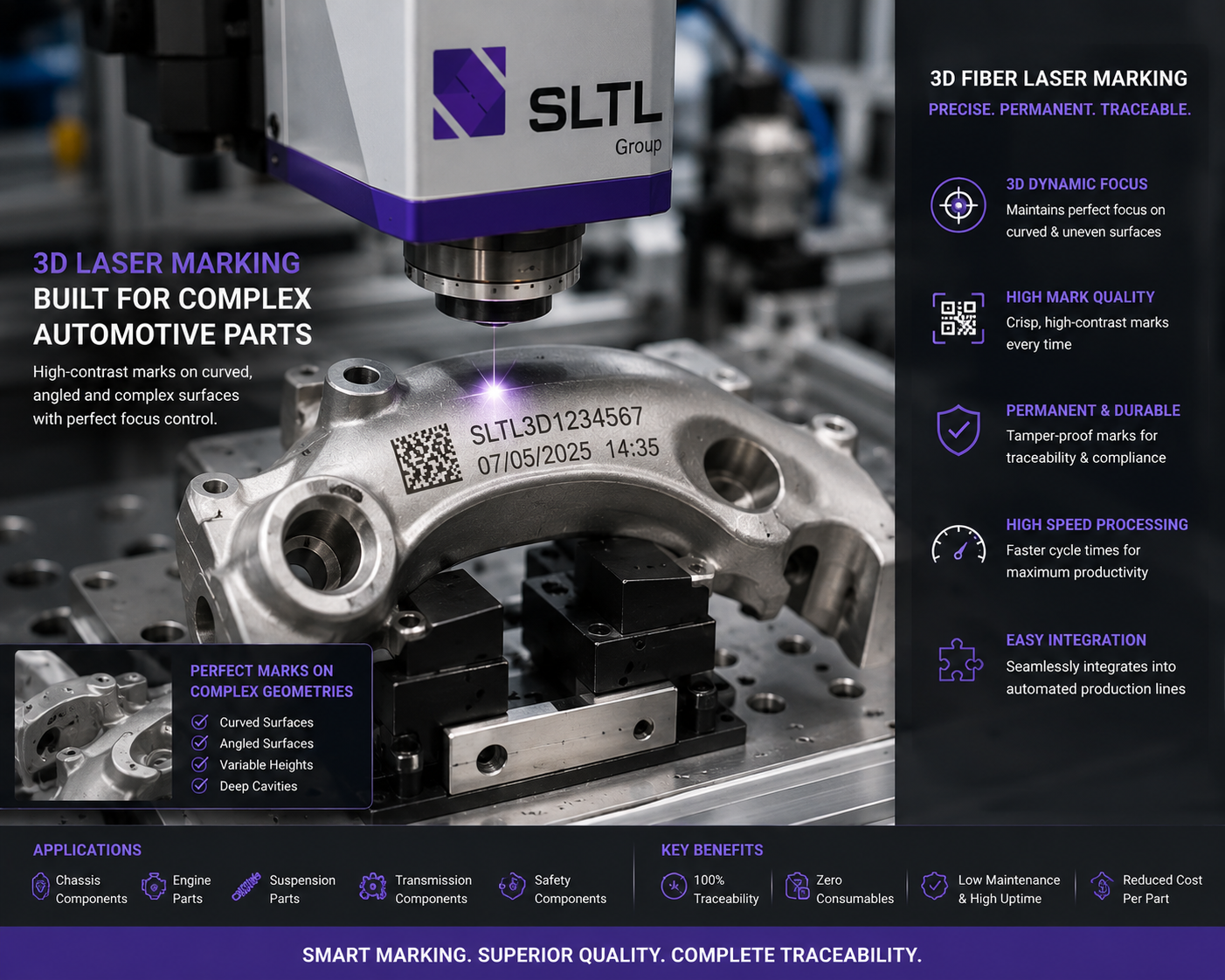
In a complete laser production environment, cutting is the first step. After chassis and tube components are cut, they move to laser welding for structural assembly. Laser marking then applies piston ring identification, 2D/3D DataMatrix traceability codes, part numbers, and chassis batch identifiers.
These technologies work together across the full production cycle. The precision of the cut directly affects welding quality. The traceability of marking connects every component to its production record. And the power selection decision in cutting affects the entire downstream chain.
For automotive manufacturers evaluating tube laser cutting alongside sheet processing, SLTL’s tube laser cutting systems offer the integrated capability that covers both applications. Learn more about tube laser cutting solutions for automotive frame and exhaust production.
Suggested video embed here: A reel comparing fiber laser cutting speeds at different power levels on automotive chassis steel — showing the relationship between power, thickness, and cut speed. “Checkout the reels made by interns for posting on your blogs.”
SLTL Laser Cutting Solutions for Automotive Manufacturing
SLTL Group offers a laser cutting range that covers the full power spectrum relevant to automotive sheet and tube production. Each platform is designed for specific production environments — not as a generic industrial machine, but as a system matched to the production requirements it will serve.
Future X — Advanced Laser Cutting Machine
The Future X is SLTL’s most advanced laser cutting platform. It combines smart automation features, precision CNC control, and high-power fiber laser capability to give automotive suppliers a genuine competitive production edge.
The Future X is designed for manufacturers who need to handle a wide range of material thicknesses, complex part geometries, and high-volume production targets on a single platform. Furthermore, its automation features — automated loading, tower storage compatibility, and MES integration — make it the right choice for suppliers building toward Industry 4.0 production environments.
Explore SLTL’s industrial fiber laser cutting systems and power options for your automotive application.
Infinity F1 — High Power Laser Cutting Machine
The Infinity F1 is built for heavy-duty automotive manufacturing. It handles the thick structural sections — 8 mm to 25 mm — that chassis rail fabrication and heavy structural component production demand. Moreover, it sustains high-power output continuously through extended production cycles.
For automotive suppliers whose production mix includes both medium-gauge body components and heavy structural chassis sections, the Infinity F1 delivers the power range to handle both without compromise.
IntegreX — Affordable Laser Cutting Machine
The IntegreX makes professional-grade laser cutting accessible for tier-2 and tier-3 automotive suppliers. It covers the thin-to-medium sheet range (0.8–6 mm) that body panels, brackets, and standard structural components require. Furthermore, it delivers genuine production capability — clean edges, accurate dimensions, and automation-ready operation — at an accessible acquisition cost.
For suppliers currently running plasma or mechanical cutting on standard automotive sheet thicknesses, the IntegreX provides the practical laser upgrade path. Discover SLTL’s automotive sheet metal cutting technology for your production tier.
X5 — 3D Laser Cutting Machine
The X5 specialises in three-dimensional cutting for complex automotive components. It handles formed panels, hydroformed sections, and three-dimensional structural nodes that flat-bed systems cannot reach. Moreover, the X5 supports post-forming trim operations where cutting happens on a curved or compound surface — replacing hard tooling with a flexible digital process.
Upgrade Automotive Production with SLTL Laser Technology
The automotive manufacturers who get laser cutting machine power selection right gain a production advantage that compounds over the system’s operational life — better parts, faster throughput, lower per-part cost, and a manufacturing capability that scales with OEM demand.
SLTL’s laser cutting, welding, and marking solutions give automotive manufacturers the complete production toolkit for modern precision fabrication.
What SLTL laser cutting delivers:
- Faster production — power-matched systems cut at optimal speed for every material and thickness
- Better cut quality — clean edges, minimal HAZ, and near-zero dross on optimised parameters
- Smart automation — CNC programme control, automated loading, and MES integration
- Precision manufacturing — consistent dimensional accuracy across every part in a production run
- Reduced operational cost — power-matched systems minimise energy consumption per part
- Improved productivity — eliminated secondary operations reduce total cycle time
- Industry 4.0 readiness — digital-native platforms compatible with connected production environments
Contact SLTL today to discuss your specific production requirements, request a power recommendation for your material and thickness mix, or arrange a demonstration on your production geometry.
Conclusion
Proper laser cutting machine power selection is not a specification detail — it is a production strategy decision. Too little power creates speed bottlenecks on thicker sections. Too much power increases operating costs without quality benefit on standard automotive sheet thicknesses. The right power selection matches the machine’s output precisely to the material, thickness, production volume, and application mix it will handle.
Furthermore, power selection does not exist in isolation. The cutting machine is one element of a broader laser production system — alongside laser welding for structural assembly and laser marking for component traceability. Getting the power right in cutting ensures that quality and precision flow through to every subsequent production step.
SLTL’s range of laser cutting platforms — from the IntegreX for accessible entry-level capability to the Infinity F1 for heavy-duty structural production — gives automotive manufacturers the power options to match their specific production requirements. The right platform is the one that cuts your material, at your volume, at your quality standard, at the lowest cost per part.
Frequently Asked Questions
Q1: What laser power do I need to cut 6 mm mild steel chassis components at production speed?
A 6 kW fiber laser system cuts 6 mm mild steel at production-acceptable speeds with excellent edge quality for most automotive applications. If your production mix includes thicker sections (8–12 mm) alongside 6 mm, a 10–12 kW system provides better throughput on the heavier material without compromising quality on the thinner sections. The right answer depends on your full thickness range and volume targets.
Q2: Does laser power selection differ for aluminium compared to mild steel?
Yes. Aluminium’s higher reflectivity requires 20–40% more laser power than mild steel to achieve equivalent cutting speeds at the same thickness. Furthermore, aluminium cutting uses nitrogen assist gas to prevent edge oxidation. Therefore, a supplier switching from mild steel to aluminium production needs to account for this power requirement difference in their specification.
Q3: What power range is suitable for automotive tube laser cutting?
Most automotive tube applications — exhaust tubes (1.5–3 mm wall), seat frame tubes (2–4 mm wall), and chassis frame tubes (3–8 mm wall) — are well-served by 4–8 kW systems. This power range handles the standard automotive tube thickness range at good production speed. Higher power (10 kW+) benefits suppliers cutting large-diameter, thick-wall structural tube at high volume.
Q4: How does laser power affect the operational cost per part in automotive production?
Higher-power laser systems consume more electrical energy per operating hour. On thin automotive sheet (0.8–3 mm), a high-power system does not cut significantly faster than a mid-power system — so the energy cost per part is higher without speed benefit. Correct power selection minimises energy cost per part by matching power output to the actual requirement of the material and thickness being cut.
Q5: Can one laser cutting machine handle both sheet and tube cutting in automotive production?
Some platforms include tube cutting attachments for basic round and square profiles alongside flat sheet capability. For serious tube processing — complex joint geometries, multiple profile types, high volumes — a dedicated tube laser cutting machine with a full rotary axis is more appropriate. SLTL’s range includes both integrated and dedicated systems, matched to specific production mixes.