Chassis fabrication sets the dimensional foundation for everything that follows in vehicle assembly. Every chassis rail, sub-frame bracket, structural cross-member, and reinforcement plate must be cut to exact specification — because inaccuracy at the cutting stage propagates through welding, assembly, and final inspection as a compounding problem that is always more expensive to fix downstream.
A chassis laser cutting machine is the production technology that delivers this accuracy at scale. It cuts automotive structural steel, aluminium alloy, and AHSS with dimensional precision, burr-free edges, and the production speed that modern automotive fabrication requires. It does this without tooling, without post-cut grinding, and without the dimensional drift that plasma and mechanical cutting introduce over long production runs.
This blog covers what to look for in a chassis laser cutting machine, how laser cutting improves automotive fabrication efficiency, and which SLTL platforms deliver the right combination of power, precision, and automation for your specific production environment.
Why a Chassis Laser Cutting Machine Matters in Automotive Fabrication
Chassis components carry the vehicle’s structural load. Every bracket, rail, and cross-member must meet tight dimensional standards — not because those standards are arbitrary, but because they determine weld fit-up quality, assembly alignment, and the structural integrity of the finished chassis.
Dimensional Accuracy Is a Structural Requirement
A chassis bracket that is 0.5 mm off specification in one dimension may not fit the welding fixture correctly. When it does not fit the fixture, the welder adjusts — and that adjustment introduces variability in the weld joint geometry that affects structural performance. Laser cutting eliminates this problem at the source.
A chassis laser cutting machine holds positioning accuracy of ±0.05–0.1 mm across the full cutting table. The ten-thousandth part is dimensionally identical to the first. As a result, assembly fixtures perform as designed, weld joints form at the correct geometry, and structural performance is consistent across the production run.
High Repeatability Reduces Production Errors
Conventional chassis cutting — plasma, mechanical punching, or saw — produces dimensional variation that increases over time as tooling wears. Laser cutting has no tooling to wear. The CNC programme defines the cut geometry and the laser follows it without deviation, consistently, throughout the production run.
Furthermore, programme changeover between part variants requires under 60 seconds — no tooling change, no fixture reset. For suppliers managing multiple chassis variants across platform families, this flexibility is a direct operational advantage.
Smart Automation Integration
Modern automotive production lines run at high utilisation with automated loading, nesting, and unloading systems. A chassis laser cutting machine integrates directly with tower storage systems, robotic loading, conveyor output, and MES production scheduling platforms. Consequently, the cutting process operates at full production speed without manual intervention — feeding downstream welding and marking operations continuously.
The broader shift toward laser-based production in automotive manufacturing — covering not just cutting but welding and marking as an integrated system — is explained in detail in Why Automotive Part Makers Are Moving from Conventional Cutting to Laser Cutting. It is the essential context for understanding why chassis fabricators are making this investment.
Key Features to Look for in a Chassis Laser Cutting Machine
Not every laser cutting machine is the right machine for chassis fabrication. The right specification depends on your material mix, thickness range, production volume, and automation requirements. Here is what to evaluate.
Laser Power Range
Power is the primary determinant of cutting speed on thick chassis steel. Chassis components range from 1.5 mm body brackets to 12–20 mm structural rails. The power required to cut these thicknesses at production speed varies significantly.
- 3–6 kW — thin-to-medium chassis sheet (0.8–6 mm). Body brackets, reinforcement plates, floor pan sections.
- 6–12 kW — medium-to-heavy chassis sections (4–16 mm). Sub-frame members, chassis rails, structural plates.
- 12–20 kW and above — heavy structural chassis sections (10–25 mm). Heavy rails, thick structural reinforcements, EV chassis structural plates.
Selecting the right power for the thickest section in your production mix — while remaining efficient on the thin sections — is the core of power specification. Over-specifying increases capital and energy cost. Under-specifying creates a production bottleneck on thick sections.
Bed Size and Material Handling
Chassis components are often larger than standard sheet format. Full-length chassis rails may require 6 m cutting capacity. Sub-frame assemblies may need 3 m × 1.5 m table formats. Confirm that the machine’s working envelope accommodates your largest chassis blank before specifying.
Additionally, automation compatibility — tower storage, automated sheet loading, conveyor unloading — determines whether the machine can sustain the production rate the line demands without manual intervention.
Edge Quality for Weld Preparation
Chassis parts go directly to welding after cutting. Edge quality from the cutting process determines weld joint fit-up and the need for secondary grinding. A well-specified chassis laser cutting machine produces burr-free, square-edge cuts on all chassis thicknesses — eliminating grinding before welding and the quality variability that manual edge dressing introduces.
Tube Cutting Integration
Many chassis fabrication environments cut both flat sheet components and tube sections — frame members, cross-members, and seat structure tubes. Some laser platforms include tube cutting capability alongside flat sheet. For suppliers processing both, a combined flat-and-tube platform or a dedicated tube laser cutting machine alongside a flat-sheet system is worth evaluating.
For the specific considerations around tube laser cutting for automotive frame and exhaust applications, SLTL’s automotive tube laser cutting solutions provides detailed specification guidance.
Software Integration and Smart Factory Compatibility
A chassis laser cutting machine in a modern automotive production environment needs to communicate with production scheduling systems, nesting software, and quality management platforms. Confirm that the machine’s software supports standard industrial protocols — OPC-UA, Ethernet — and that nesting optimisation software integrates with your production planning workflow.
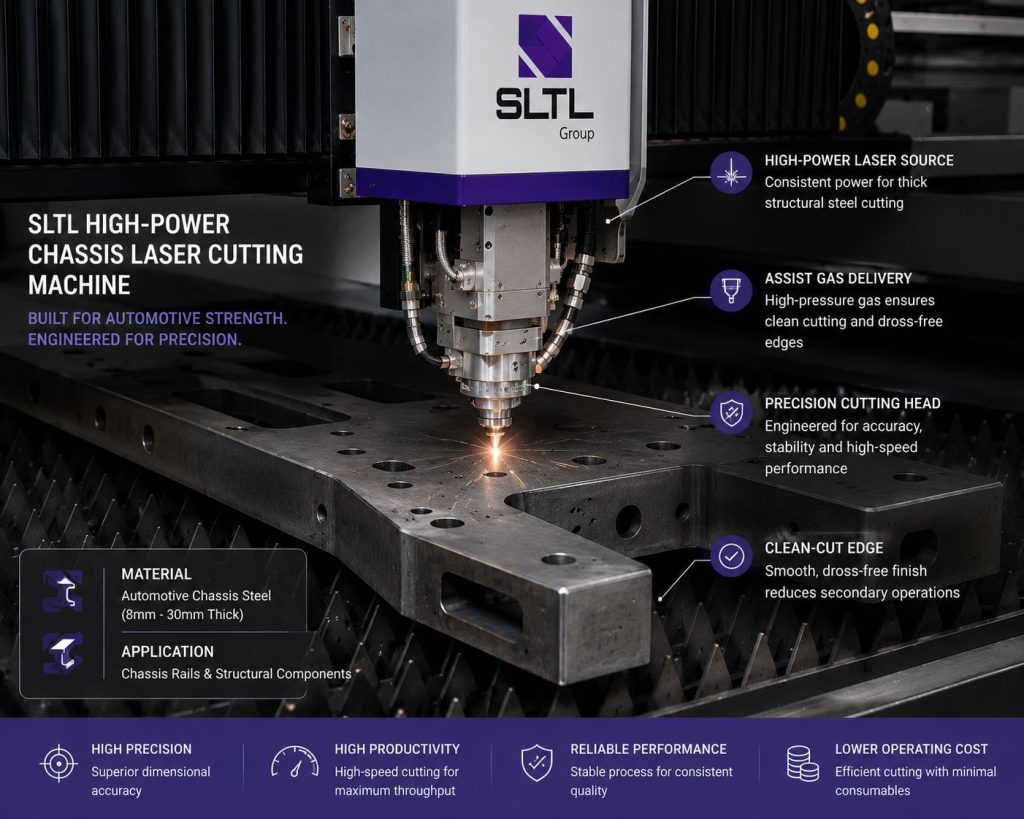
Suggested image here: A SLTL high-power chassis laser cutting machine processing thick automotive structural steel — showing the cutting head, assist gas, and clean-cut edge on a chassis rail blank. Image format: WEBP ALT text:
Chassis laser cutting machine used for precision automotive fabrication and structural component manufacturing
How Laser Cutting Machines Improve Automotive Fabrication Efficiency
High-Speed Chassis Cutting for Automotive Manufacturing
On standard chassis sheet thicknesses (3–6 mm mild steel), modern fiber laser cutting machines run significantly faster than plasma at equivalent edge quality. Moreover, on thin-gauge brackets and body reinforcements (0.8–2 mm), laser cutting speed advantages over plasma and mechanical punching are even more pronounced.
Higher throughput per shift means lower cost per part. Additionally, faster cutting speed reduces the queue between the cutting station and downstream welding — keeping the full production line running at capacity.
Precision Sheet and Tube Processing with Laser Technology
Dimensional accuracy from the cutting station determines the quality of every subsequent production step. Weld fixture fit-up, assembly alignment, and structural performance all depend on the chassis parts arriving at specification.
A chassis laser cutting machine holds ±0.05–0.1 mm across the working envelope. Furthermore, because the CNC programme does not drift or wear, this accuracy is consistent from the start of a production run to the end — regardless of shift length or production volume.
Smart Automation in Automotive Fabrication
Automated production lines achieve higher utilisation and lower labour cost per part than manually operated equivalents. SLTL chassis laser cutting systems integrate with tower storage systems that store and automatically retrieve sheet stock, automated loading systems that feed the cutting table without operator involvement, and conveyor systems that carry cut parts directly to downstream welding cells.
Consequently, a laser cutting cell can run at near-continuous utilisation — processing chassis components across multiple shifts with minimal direct operator involvement.
Reduced Secondary Finishing
Plasma-cut chassis parts almost always require deburring or edge grinding before welding. Laser-cut parts typically do not. The edge from a well-specified laser cutting process is clean, square, and ready for direct welding — eliminating the secondary operation and the quality variable it introduces.
In a high-volume chassis fabrication environment, eliminating deburring on every cut part saves significant labour cost and cycle time per shift.
Suggested video embed here: A reel showing high-speed laser cutting on automotive chassis steel — full-thickness structural rail cutting, nesting optimisation, and cut-edge quality close-up. “Checkout the reels made by interns for posting on your blogs.”
Best SLTL Machines for Chassis Cutting and Automotive Fabrication
SLTL Group provides a complete range of chassis laser cutting machines for automotive fabrication — from accessible mid-power platforms for tier-2 suppliers to advanced high-power systems for volume OEM chassis production.
Future X — Advanced Laser Cutting Machine
The Future X is SLTL’s most advanced chassis laser cutting platform. It combines smart automation features, high-power fiber laser cutting capability, and precision CNC control in a system designed to give automotive chassis manufacturers a genuine competitive edge in production speed and part quality.
The Future X handles the full range of chassis sheet thicknesses — from thin body brackets to medium structural members — with parameter optimisation per material and thickness. Smart automation features include automated nesting, tower storage integration, and MES connectivity for Industry 4.0 production environments.
For automotive chassis manufacturers who need the most capable platform available, the Future X is the benchmark against which other systems should be measured. Explore SLTL’s chassis laser cutting machine solutions for your production environment.
Infinity F1 — High Power Laser Cutting Machine
The Infinity F1 is purpose-built for heavy-duty automotive chassis fabrication. It handles the thick structural steel sections — 8 mm to 25 mm — that chassis rail fabrication and heavy structural component production demand. Moreover, it sustains high-power output across extended production duty cycles without performance degradation.
For automotive suppliers cutting heavy chassis rails, thick sub-frame structural plates, and large-format structural reinforcements, the Infinity F1 delivers the sustained cutting power and edge quality that heavy structural steel demands at production volume.
Its high-power configuration also enables nitrogen-assisted cutting on thick stainless steel — relevant for EV structural chassis components and stainless structural members in premium vehicle platforms.
IntegreX — Affordable Laser Cutting Machine
The IntegreX makes precision chassis laser cutting accessible for tier-2 and tier-3 automotive suppliers. It processes standard chassis sheet thicknesses — 0.8 mm to 8 mm — with genuine production capability and laser-quality edge finishing. Furthermore, it delivers the production efficiency improvements — eliminated secondary operations, faster cycle times, better dimensional accuracy — that justify laser cutting at an accessible acquisition cost.
For chassis fabricators currently running plasma or mechanical punching for standard chassis bracket and reinforcement plate production, the IntegreX is the practical upgrade path. Discover SLTL’s automotive fabrication laser systems for your production tier.
X5 — 3D Laser Cutting Machine
The X5 specialises in three-dimensional cutting on complex automotive chassis components. It handles the compound surface cutting, formed panel trimming, and structural node geometry that flat-bed systems cannot process — replacing hard trim tooling with a flexible, digitally programmed laser cutting process.
Additionally, the X5 supports chassis applications where cutting happens on formed or hydroformed sections after the primary forming operation. Design changes require only a programme update — no new hard tooling, no qualification delay.
For EV chassis manufacturers working with complex formed aluminium structures or composite chassis panels, the X5 provides the 3D cutting capability that conventional flat-bed systems cannot deliver.
Applications of Laser Cutting in Automotive Manufacturing
Chassis Rail and Cross-Member Cutting
Chassis rails, longitudinal members, and cross-member blanks require cutting at high volume to tight dimensional specifications. A chassis laser cutting machine handles these components from standard sheet stock — with optimised nesting to maximise material yield and consistent edge quality on every cut.
EV Battery Housing and Structural Tray Production
EV battery housing structures use aluminium alloy in complex shapes that require both flat sheet cutting and formed section trimming. Laser cutting handles both — flat sheet for enclosure panels and formed sections on the X5 for post-forming trim operations — with the aluminium-specific parameters that produce clean, weld-ready edges without the heat distortion that mechanical cutting introduces.
Structural Reinforcement and Gusset Cutting
A-pillar gussets, B-pillar reinforcements, and underbody structural plates all require precision cutting in high-strength steel that plasma struggles to cut accurately. A chassis laser cutting machine delivers these components to weld-ready specification, batch after batch, without the tool wear that degrades plasma quality on AHSS over a production run.
Tube Cutting for Frame and Exhaust Systems
Chassis cross-tube members, seat structure tubes, and exhaust manifold sections all require laser cutting. Additionally, the complex joint geometries — bevel cuts, saddle notches, and through-holes — that frame assembly requires are produced in a single automated operation on a tube laser cutting machine, eliminating secondary sawing and notching operations.
Integrated Laser Production in Automotive Fabrication
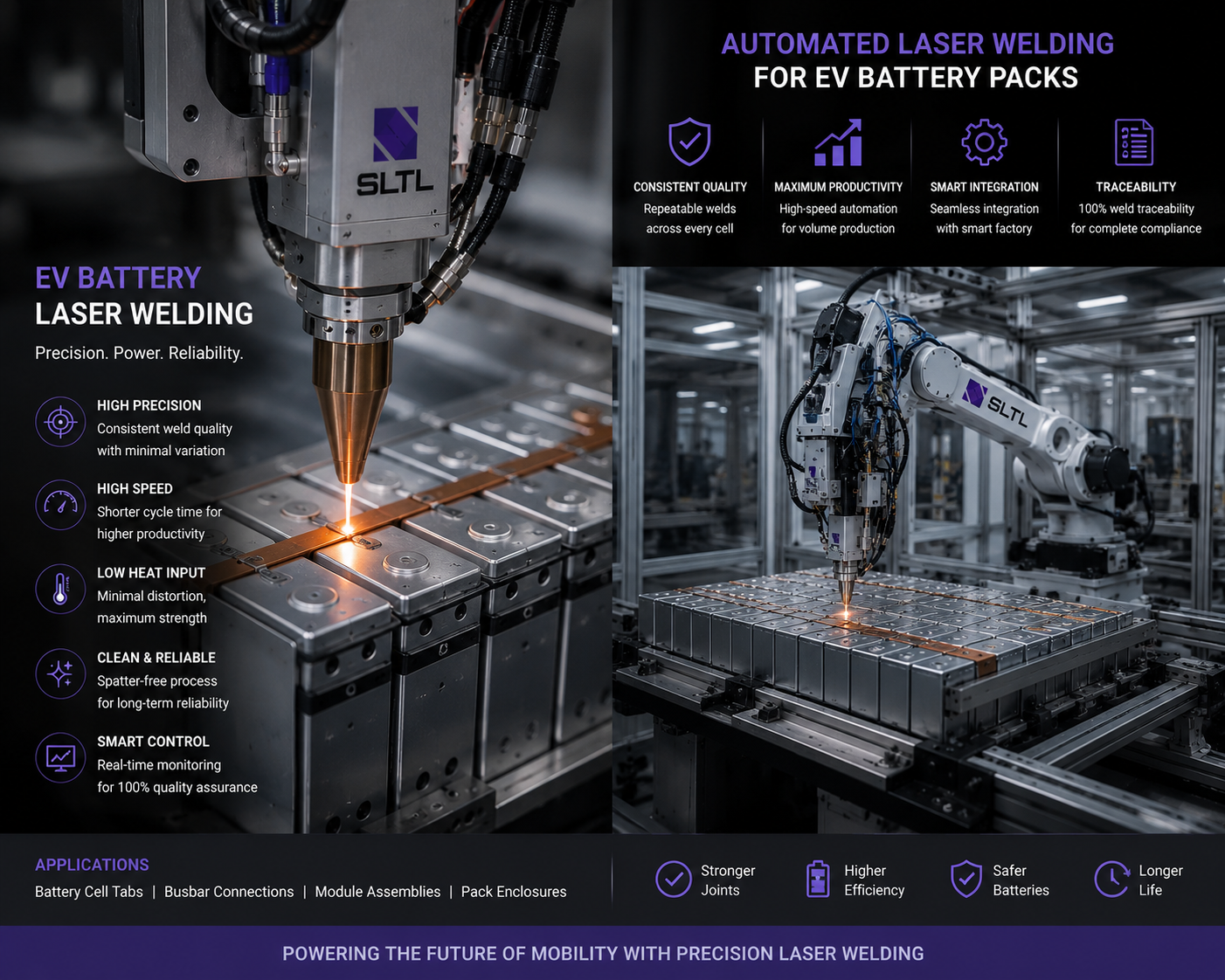
Laser cutting is most effective as part of a complete production system. Cut chassis components move directly to laser welding — where accurate laser-cut edges enable tight joint fit-up and high-quality welds without grinding or fitting. After welding, laser marking applies traceability codes, piston ring identifiers, 2D/3D DataMatrix marks, and chassis component batch IDs.
These technologies — cutting, welding, and marking — work together as an integrated automotive laser production system. The precision of the cutting step determines the quality of the welding step. The traceability of the marking step connects every component to its production record. Together they deliver the smart, precision automotive production that modern OEMs demand.
Invest in the Right Chassis Laser Cutting Machine with SLTL
Automotive chassis fabricators are under continuous pressure — tighter tolerances, faster delivery, more complex part geometries, and less tolerance for rework and secondary operations. A correctly specified chassis laser cutting machine addresses all of these pressures simultaneously.
SLTL’s laser cutting, welding, and marking solutions give chassis fabricators the complete production toolkit for modern precision automotive manufacturing.
What SLTL chassis laser cutting delivers:
- Faster chassis fabrication — high cutting speeds on all chassis steel and aluminium thicknesses
- Better edge quality — burr-free, square-edge cuts ready for direct welding without grinding
- Smart automation — tower storage, robotic loading, MES integration, and nesting software
- Reduced operational cost — eliminated secondary operations, lower consumable cost, better material yield
- Precision manufacturing — ±0.05–0.1 mm dimensional accuracy consistent across full production runs
- High-speed production — sub-minute programme changeover between chassis variants
- Industry 4.0 readiness — digital-native CNC systems built for connected automotive production
Contact SLTL today to discuss your chassis cutting application, request a sample cut on your specific material and thickness, or compare platform specifications for your production volume and geometry requirements.
Conclusion
Modern automotive chassis fabrication demands a cutting process that is precise, fast, consistent, and automation-ready. A chassis laser cutting machine delivers all four — producing weld-ready parts at dimensional accuracy that plasma and mechanical cutting cannot sustain, at production speeds that keep downstream welding and assembly operations running at full capacity.
Furthermore, laser cutting delivers its maximum value as part of an integrated production system. Combined with laser welding for structural assembly and laser marking for component traceability, it supports a complete production workflow that is more precise, more traceable, and more efficient than conventional fabrication at every step.
SLTL’s range of chassis laser cutting systems — from the IntegreX for accessible entry-level capability to the Infinity F1 for heavy-duty structural steel production — gives automotive chassis manufacturers the platform to match their specific production requirements. The right machine is the one that cuts your material, at your volume, at your quality standard, at the lowest cost per part.
Frequently Asked Questions
Q1: What laser power do I need for chassis laser cutting on structural automotive steel?
For standard chassis sheet in the 3–8 mm range, a 6–10 kW fiber laser system delivers production-acceptable speeds with excellent edge quality. For heavy structural sections in the 10–20 mm range — chassis rails, thick sub-frame plates — a 12–20 kW system provides the power to cut at production speed without compromising edge quality. The right specification depends on your full thickness range and volume targets.
Q2: Can a chassis laser cutting machine handle both sheet and tube cutting?
Some platforms include tube cutting attachments for standard round and square profiles alongside flat sheet cutting. For serious tube processing — complex joint geometries, large diameter ranges, high volume — a dedicated tube laser cutting machine alongside a flat-sheet chassis cutter is often the better specification. SLTL offers both integrated and dedicated platforms, matched to specific production mixes.
Q3: How does laser cutting edge quality compare to plasma for chassis weld preparation?
Laser cutting produces square, near-burr-free edges with surface roughness of 3–8 µm on typical chassis steel. Plasma cutting produces edges with visible dross, oxidation, and bevel that typically require grinding before welding. Consequently, laser-cut chassis parts move directly to welding — eliminating the secondary grinding step that plasma always introduces, along with the labour cost and quality variability it carries.
Q4: What is the programme changeover time between different chassis part variants on a laser cutting machine?
Programme changeover on a CNC laser cutting system takes under 60 seconds — load the new part programme, confirm parameters, begin cutting. There is no physical tooling to swap or re-qualify. For chassis fabricators managing multiple variants across platform families, this sub-minute changeover is a direct production efficiency advantage over conventional tooling-based processes.
Q5: How does a chassis laser cutting machine integrate with automated production lines?
SLTL chassis laser cutting machines integrate with tower storage systems for sheet stock management, automated loading and unloading conveyors, MES production scheduling platforms, and nesting software for material optimisation. Consequently, the laser cutting cell operates at near-continuous utilisation across multiple shifts with minimal direct operator involvement — fully compatible with Industry 4.0 smart factory production architectures.