
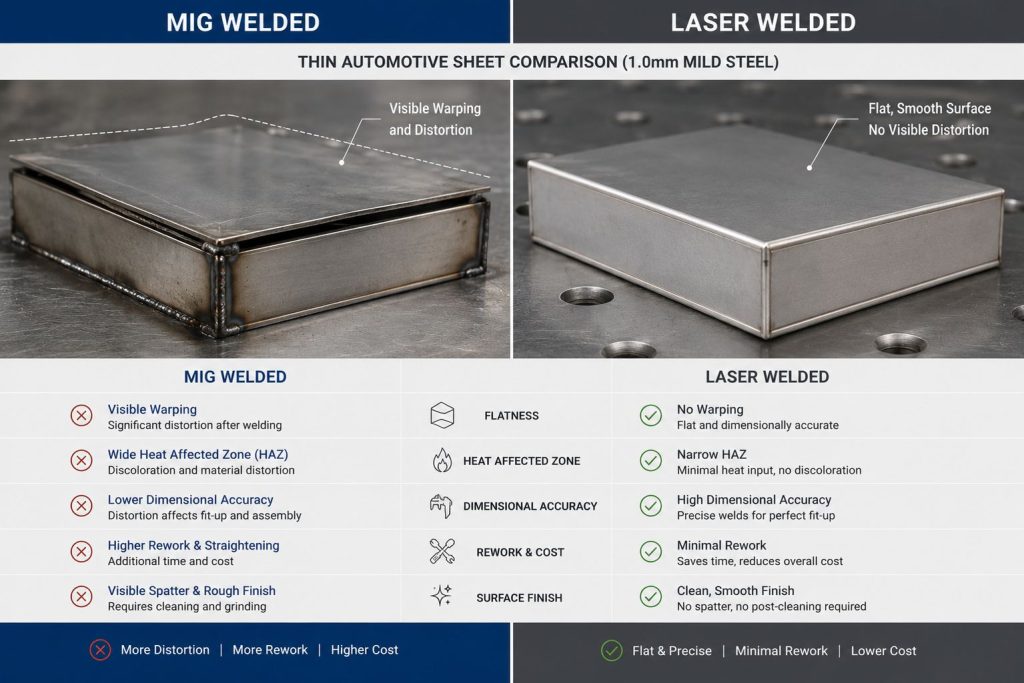
Welding distortion is one of the most persistent quality problems in automotive manufacturing. When a chassis bracket warps after welding, it does not fit the assembly fixture. When a thin EV battery enclosure distorts from heat, the hermetic seal fails. A structural sheet metal assembly comes off the weld line with dimensional variation, it creates alignment problems at every downstream station.
Laser welding distortion control addresses this problem at the process level — not through post-weld correction, but by delivering precisely the amount of heat the joint needs and no more. The result is low distortion welding that maintains dimensional accuracy across the full automotive assemblies production run. As vehicle designs grow lighter, thinner, and more geometrically precise, distortion control is no longer a secondary quality metric — it is a fundamental process requirement.
This blog explains how laser welding controls distortion, where it delivers the most significant quality improvement in automotive manufacturing, and which SLTL systems are built for precision assembly welding.
Why Laser Welding Distortion Control Matters in Automotive Manufacturing
Distortion in welded automotive assemblies is not just a cosmetic problem. It affects dimensional conformance, downstream assembly fit, weld quality at subsequent joints, and the structural performance of the finished component.
Distortion Drives Rework and Scrap
A chassis assembly that exits the welding station 1.5 mm out of alignment requires correction before it enters the body shop. That correction — whether by fixturing under load, grinding, or re-welding — adds labour cost, adds cycle time, and introduces a quality variable that does not exist in correctly welded parts.
Furthermore, in high-volume production environments, even a small distortion rate per part multiplies into significant rework volume per shift. As a result, distortion is a direct driver of production cost in ways that are easy to underestimate at the process specification stage.
Thin Materials and Lightweight Structures Are Most Vulnerable
Modern automotive design uses thinner gauge steel, advanced aluminium alloys, and lightweight AHSS grades to reduce vehicle weight. These materials are more susceptible to welding distortion than the thicker sections they replace.
Moreover, EV platform structures use thin aluminium for battery enclosures and structural trays — materials where conventional MIG welding heat input causes warping that compromises both dimensional accuracy and the hermetic sealing requirements of battery enclosures.
Precision Assembly Requirements Are Getting Tighter
Body-in-white assembly, chassis fabrication, and EV battery assembly all operate to tighter dimensional tolerances than previous generation vehicle platforms. Assembly fixtures designed to ±0.3 mm tolerances cannot accommodate welded parts that have distorted by 1–2 mm from the process heat.
Therefore, laser welding distortion control is not a premium option for precision manufacturers — it is a baseline requirement for suppliers working to modern OEM dimensional specifications on thin and complex assemblies.
The shift toward laser-based production in automotive manufacturing — covering cutting, welding, and marking as an integrated system — is covered in Why Automotive Part Makers Are Moving from Conventional Cutting to Laser Cutting. It provides the full context for why distortion control is one of the primary drivers of the move toward laser welding.
Benefits of Laser Welding Distortion Control for Precision Assemblies
The physics of laser welding explain why it produces less distortion than arc-based welding processes. The manufacturing advantages follow directly from these physical characteristics.
Low Heat Input — The Root Cause of Distortion Control
Distortion in any welding process is caused by uneven thermal expansion and contraction around the weld joint. The more heat the process deposits in the surrounding material, the more the material expands, contracts, and moves during and after the weld cycle.
Laser welding delivers focused energy to a spot typically 0.1–0.3 mm in diameter. The weld bead forms quickly — high travel speeds mean the heat input per unit length is far lower than MIG or TIG welding at equivalent penetration. Consequently, the surrounding material reaches lower peak temperatures, expands less, and contracts less after the weld completes.
Narrow Heat-Affected Zone
The heat-affected zone (HAZ) in laser welding is typically 0.1–0.5 mm wide on standard automotive steel and aluminium thicknesses. Conventional MIG welding produces HAZ widths of 3–8 mm on the same material.
The HAZ is the region where the base metal’s microstructure changes due to welding heat. In this zone, residual stresses accumulate — and these stresses drive the distortion that occurs as the assembly cools. A narrow HAZ means less material affected, less residual stress, and consequently less distortion in the finished assembly.
Reduced Warping on Thin Sheet
On 0.8–2 mm automotive sheet metal — body panels, EV enclosure skins, heat shield assemblies — arc welding heat input regularly causes visible warping. The thin sheet cannot absorb and distribute the heat fast enough to prevent localised thermal distortion.
Laser welding’s fast travel speed and concentrated energy deliver full penetration on thin sheet with dramatically less heat input. Furthermore, the narrow weld bead geometry — typically 0.3–1.5 mm wide on thin sheet — minimises the thermal gradient across the sheet, reducing the differential expansion that drives warping.
Better Dimensional Stability After Welding
Assemblies welded with laser maintain closer dimensional conformance after cooling than arc-welded equivalents. This is a direct consequence of lower residual stress in the HAZ and less overall thermal distortion during the weld cycle.
For chassis assembly fixtures designed to tight tolerances, this dimensional stability means parts fit correctly from the first cycle — without shimming, re-fixturing, or post-weld correction.
High Repeatability Across Production Runs
Laser welding parameters — power, travel speed, focus position, shielding gas — are set digitally and remain constant across every weld in a production run. Consequently, every assembly in a batch has the same weld geometry, the same HAZ, and the same post-weld dimensional accuracy.
This repeatability is what makes laser welding distortion control a production-level quality tool, not just a process capability. The distortion behaviour of the first assembly predicts the distortion of the ten-thousandth assembly — making fixture design and downstream process planning reliable.
How Low Distortion Welding Improves Automotive Production Quality
The quality improvements from laser welding distortion control cascade through the production process — affecting not just the weld quality of individual components but the assembly quality, throughput, and rework rates of the complete production system.
Low Heat Input Welding for Thin Automotive Parts
Thin automotive components — door inners, floor pan sections, roof inners, heat shields — are the most distortion-sensitive parts in body-in-white production. Conventional spot welding and MIG seam welding on these components routinely require post-weld straightening or planishing to restore dimensional accuracy before the assembly moves to the paint shop.
Laser seam welding on these components eliminates post-weld straightening in most applications. The low heat input keeps the sheet flat throughout and after the weld cycle. Furthermore, the continuous seam weld capability of laser systems provides better structural performance and better appearance quality than spot welding on visible body panel assemblies.
Precision Laser Welding for EV Battery Assemblies
EV battery enclosures represent the most demanding automotive laser welding application. These are thin aluminium assemblies that require hermetic sealing — a single leak path in the enclosure is a product safety failure.
Laser welding delivers hermetic-quality seals on thin aluminium battery enclosures through controlled, repeatable, low-distortion weld seams. The focused energy and fast travel speed maintain dimensional accuracy on the thin-walled enclosure — preventing the warping that would compromise the sealing surface geometry.
Additionally, busbar welding on cell interconnects and module electrical connections requires precision energy delivery on dissimilar metals (copper to aluminium) that arc welding cannot achieve reliably. Laser welding handles these connections cleanly, with the controlled heat input that prevents thermal damage to adjacent cell chemistry.
Distortion Reduction in Chassis and Structural Welding
Chassis rails, sub-frame assemblies, and structural node connections require weld strength without dimensional distortion. A chassis assembly that exits the welding cell 2 mm out of tolerance creates alignment problems at body-in-white that propagate through every subsequent assembly step.
Laser welding on chassis structural joints delivers deep, narrow weld beads with low distortion — strong joints at accurate geometry, consistently, across production volume. Moreover, laser-cut chassis parts arrive at the welding fixture with accurate edge geometry and minimal HAZ from the cutting process. Consequently, joint fit-up is tighter, weld gaps are smaller, and distortion from fit-up correction is eliminated.
For the cutting side of this integrated workflow, SLTL’s automotive laser cutting solutions deliver the same precision to the cutting process that laser welding delivers to the joining process.
Minimal Post-Processing Requirements
Arc-welded automotive assemblies commonly require post-weld grinding, planishing, and dimensional correction before they move to the next production stage. These secondary operations add labour, add cycle time, and introduce a quality variable that depends on operator skill and attention.
Laser welded assemblies typically move from the welding station directly to the next process step — without post-weld correction. The dimensional accuracy is built into the process. As a result, total production cycle time falls and throughput increases without any additional investment in correction operations.
Automation Compatibility for Industry 4.0
Laser welding systems integrate directly with robotic production cells, gantry welding systems, and CNC motion platforms. The weld programme is digital, the beam delivery is consistent, and the process does not require manual intervention in the weld cycle.
Robotic laser welding on body-in-white assemblies achieves positioning accuracy of ±0.05–0.1 mm — enabling consistently accurate weld placement across complex three-dimensional joint geometries at production speed.
Applications of Laser Welding Distortion Control in Automotive Assemblies
Laser welding distortion control delivers measurable quality improvements across a wide range of automotive production applications.
Chassis Structural Welding
Chassis rails, cross-members, gussets, and sub-frame nodes are the primary structural weld applications in automotive manufacturing. Low distortion laser welding on these components maintains fixture tolerance compliance across production volume — without the post-weld correction that arc welding frequently requires on tight-tolerance structural assemblies.
EV Battery Enclosure and Module Welding
Battery enclosure seam welding, module structural welding, and busbar electrical connection welding all benefit from laser’s low heat input and precise energy control. Furthermore, laser welding’s ability to join dissimilar metals (copper-to-aluminium busbars) and produce hermetic seals on thin aluminium enclosures makes it the enabling technology for EV battery production at the quality levels that safety and performance standards require.
Thin Sheet Metal Body Components
Door inners, floor pan sections, roof assemblies, and A-pillar structures all use thin gauge steel or aluminium that distorts under arc welding heat. Laser seam welding on these components delivers structural performance with dimensional accuracy — the two requirements that arc welding frequently compromises on thin section.
Tube Assembly Welding for Frames and Exhaust
Exhaust system seam welding, seat frame tube assembly, and chassis tube node connections all benefit from laser’s narrow HAZ and low distortion. Additionally, laser tube cutting provides the weld-ready tube ends that tight joint fit-up requires — eliminating the gap-filling and excess heat input that poor fit-up forces on arc welding operations.
Structural Reinforcement Welding
Door impact beams, B-pillar reinforcements, and underbody structural plates all require weld joints that maintain their geometry under impact loading. Laser welding’s high penetration, narrow bead, and low HAZ produce joints with mechanical properties that are consistently closer to the base metal than arc welding delivers — and without the dimensional distortion that compromises structural performance in formed assemblies.
Integrated Laser Production in Automotive Manufacturing
Laser welding is most effective as part of an integrated production system. Chassis components and tube sections arrive from laser cutting with accurate edge geometry and minimal cutting HAZ. They move to laser welding with tight fixture fit-up. After welding, laser marking applies DataMatrix codes, part numbers, and batch identifiers for traceability. Piston ring marking, 2D/3D job marking, and chassis identification complete the traceability picture across the full production chain.
These technologies work together — cut, weld, and mark — as a complete laser production system that delivers the precision, traceability, and throughput that modern automotive OEMs demand.
SLTL Laser Welding Solutions for Automotive Manufacturing
SLTL Group provides a complete range of laser welding systems for automotive manufacturers — covering thin sheet seam welding, structural chassis welding, EV battery assembly, and robotic automated welding applications.
Precision Laser Energy Control
SLTL laser welding systems deliver digitally controlled pulse and continuous wave energy with the stability and repeatability that precision automotive welding requires. Power settings, pulse duration, and beam focus are set per application and maintained consistently throughout the production run. Consequently, every weld in a batch receives identical energy delivery — and produces identical weld geometry and dimensional outcome.
Automated Welding Integration
SLTL welding systems integrate with robotic arms, gantry systems, and CNC motion platforms for fully automated production welding on body-in-white, chassis, and EV battery applications. The beam delivery remains consistent at full production speed — with the same accuracy on the last weld of the shift as on the first.
Reduced Heat-Affected Zones
SLTL laser welding systems operate with beam parameters optimised for minimal HAZ on each specific material and thickness. This optimisation is application-specific — developed through process trials on the customer’s actual material and joint geometry. The result is laser welding distortion control built into the process parameters, not achieved through post-weld correction.
High Repeatability for Production Quality
Digital parameter control ensures that weld quality is identical from the first assembly to the ten-thousandth. Process drift — a chronic problem in arc welding from electrode wear and operator fatigue — is eliminated. Therefore, quality control is predictable, rework rates are low, and production throughput is consistent.
Industrial Productivity Improvements
SLTL laser welding systems process automotive weld joints significantly faster than equivalent MIG or TIG operations — typically 3–10x faster on seam and structural welds. Furthermore, eliminated post-weld correction steps reduce total cycle time per assembly beyond the welding station speed alone.
Explore SLTL’s industrial automotive laser welding systems for precision assembly and chassis welding applications.
Discover how SLTL’s low distortion welding technology supports EV battery and thin sheet metal automotive production.
Upgrade Automotive Welding with SLTL Laser Technology
Automotive manufacturers who move from arc welding to laser welding on precision assemblies gain a quality advantage that compounds across every downstream production step. Better dimensional accuracy at the weld stage means better fit-up at assembly, fewer correction operations, and more consistent finished product quality.
SLTL’s laser welding, cutting, and marking solutions give automotive manufacturers the integrated production toolkit for modern precision fabrication.
What SLTL laser welding delivers:
- Reduced welding distortion — low heat input and narrow HAZ preserve dimensional accuracy on thin and complex assemblies
- Precision assembly quality — consistent weld geometry from first to last component in production run
- Faster production — 3–10x faster than arc welding on seam and structural applications
- Better dimensional accuracy — assemblies that exit the weld station fixture-accurate, without post-weld correction
- Smart manufacturing — robotic integration, digital parameter control, and MES connectivity
- Reduced rework — distortion-free assemblies eliminate post-weld straightening and correction operations
- Industry 4.0 readiness — digital-native platforms for connected, automated automotive production
Contact SLTL today to discuss your automotive welding application, request a sample weld on your specific material and joint geometry, or specify the right system for your production volume and dimensional accuracy requirements.
Conclusion
Welding distortion is a manufacturing problem with a process solution. Laser welding distortion control delivers that solution through fundamental physics — focused energy, fast travel speed, and narrow HAZ that leave surrounding material largely undisturbed while producing full-penetration, structurally sound weld joints.
For automotive manufacturers working with thin gauge steel, aluminium alloys, AHSS chassis sections, and EV battery enclosures, this distortion control capability is not a premium option. It is the difference between assemblies that consistently meet dimensional specifications and assemblies that require correction at every production step.
Furthermore, laser welding delivers its maximum value as part of an integrated production system. Combined with laser cutting for weld-ready part preparation and laser marking for component traceability, it supports a complete production workflow that is faster, more precise, and more traceable than conventional manufacturing at every step. SLTL’s laser welding, cutting, and marking solutions are built for this integrated approach.
Frequently Asked Questions
Q1: Why does laser welding cause less distortion than MIG or TIG welding on automotive parts?
Laser welding delivers focused energy to a spot typically 0.1–0.3 mm in diameter at high travel speed. This produces a very narrow heat-affected zone — typically 0.1–0.5 mm wide — compared to 3–8 mm for MIG welding on the same material. The narrower HAZ means less material reaches high temperature, less thermal expansion occurs, and consequently less residual stress and distortion develops as the assembly cools.
Q2: Which automotive materials benefit most from laser welding distortion control?
Thin gauge materials benefit most — 0.8–3 mm steel, aluminium alloys used in EV enclosures and body structures, and AHSS grades used in chassis and safety components. These materials have less thermal mass to absorb and distribute welding heat, making them most susceptible to distortion under arc welding and most improved by laser welding’s low heat input.
Q3: Is laser welding suitable for EV battery enclosure seam welding?
Yes — laser welding is the preferred process for EV battery enclosures. It produces hermetic-quality seals on thin aluminium enclosures with minimal distortion — maintaining the sealing surface geometry that battery ingress protection standards require. It also handles busbar welding on copper-to-aluminium electrical connections that arc welding cannot join reliably.
Q4: Can laser welding integrate with robotic production systems in automotive manufacturing?
Yes. Laser welding heads mount directly on robotic arms and gantry systems. The weld programme is digital, beam delivery is consistent at full production speed, and the system integrates with production scheduling and quality management platforms. Robotic laser welding achieves positioning accuracy of ±0.05–0.1 mm on complex three-dimensional joint geometries.
Q5: How much rework reduction can automotive manufacturers expect after switching to laser welding?
Rework reduction depends on the current process and component type. On thin sheet automotive assemblies currently requiring post-weld straightening, laser welding typically eliminates straightening operations entirely — reducing total rework time per assembly by 40–80%. On precision chassis assemblies requiring dimensional correction after arc welding, laser welding maintains fixture tolerance compliance from the first weld cycle, eliminating the correction step completely.
