Every automotive chassis part that leaves a cutting station carries the quality of the process that produced it. Edge condition, dimensional accuracy, and heat distortion all determine how well that part fits, welds, and performs in the finished vehicle. For decades, plasma cutting was the default for automotive chassis manufacturing. Today, manufacturers comparing laser cutting vs plasma cutting automotive applications are finding that the two technologies are not equivalent — and that the differences matter significantly for production quality, cost, and repeatability.
This is a consideration-stage decision for many automotive suppliers. Plasma cutting works. The question is whether it works well enough for the precision cutting demands of modern chassis manufacturing — or whether laser cutting delivers measurable advantages that justify the investment. This blog gives you the direct comparison to answer that question.
Laser Cutting vs Plasma Cutting Automotive: Key Differences
To make a meaningful comparison, it helps to understand what each process actually does — and where the physics of each method creates advantages or limitations for automotive chassis work.
How Plasma Cutting Works
Plasma cutting uses a high-temperature ionised gas stream — typically nitrogen, air, or argon-hydrogen — to melt and remove metal along the cut path. The plasma arc generates temperatures between 15,000°C and 25,000°C at the cut point. This extreme heat cuts through metal quickly but distributes significant thermal energy into the surrounding material in the process.
The result is a relatively wide heat-affected zone (HAZ), a cut edge with visible oxidation and dross on most steel thicknesses, and dimensional accuracy that degrades on thinner material as the plasma arc wanders. Plasma cutting works well on thick structural steel at high speed. However, it struggles with thin-gauge chassis sheet, tight geometric tolerances, and applications where weld preparation quality matters.
How Laser Cutting Works
A laser cutting machine focuses a high-energy beam — from a fibre laser source in most modern automotive systems — to a spot typically 0.1–0.3 mm in diameter at the workpiece surface. This concentrated energy melts and vaporises material along the programmed cut path with a kerf width typically 0.2–0.5 mm.
The energy concentration is the key difference. Because the laser delivers cutting energy to a tiny spot and moves quickly, the total heat input per unit length of cut is far lower than plasma. The surrounding material reaches a much lower temperature. Consequently, HAZ is measured in fractions of a millimetre rather than several millimetres — and the cut edge emerges cleaner, squarer, and with less thermal distortion.
Material and Geometry Compatibility
Both processes handle mild steel, stainless steel, aluminium, and high-strength automotive alloys. However, their performance profiles diverge significantly on thinner material and complex geometries.
On 1–4 mm automotive chassis sheet — door reinforcements, bracket assemblies, floor pan sections — laser cutting produces consistently better edge quality than plasma. hicker structural sections (8–20 mm), plasma remains competitive on raw cutting speed, though edge quality still favours laser.
On complex geometries — internal cutouts, tight corner radii, closely nested parts — laser cutting’s narrow kerf and precise CNC control produce accurate results. Plasma cutting’s arc instability on tight corners introduces dimensional error that requires correction downstream.
Laser Cutting vs Plasma Cutting Automotive: Edge Quality Comparison
Edge quality is the most visible and practically significant difference between these two processes in automotive chassis manufacturing. It affects weld preparation, assembly fit-up, surface appearance, and downstream processing requirements.
Edge Condition After Cutting
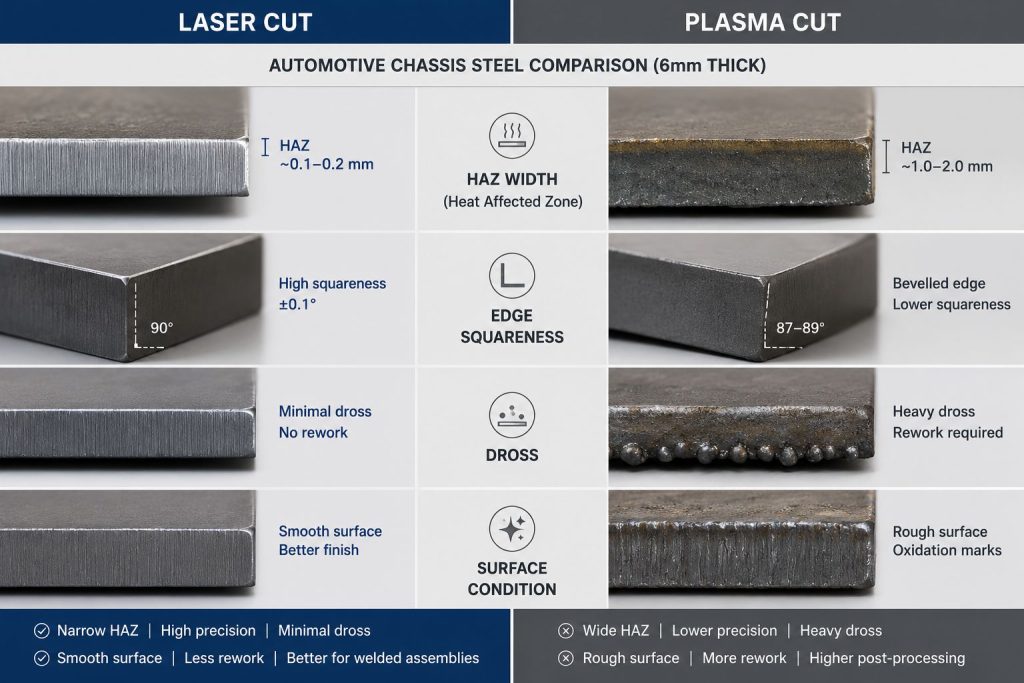
Plasma cutting produces a cut edge with:
- Visible oxidation layer (scale) on carbon steel
- Dross — resolidified metal — along the bottom edge on most thicknesses
- Angular edge profile (bevel) due to arc geometry
- Surface roughness (Ra) typically 15–30 µm
- HAZ width typically 3–8 mm on medium-gauge steel
Laser cutting produces a cut edge with:
- Minimal oxidation when nitrogen assist gas is used
- Near-zero dross on optimised cuts for most automotive sheet thicknesses
- Perpendicular edge geometry within ±0.5° on most applications
- Surface roughness (Ra) typically 3–8 µm
- HAZ width typically 0.1–0.5 mm
The practical consequence of this difference is significant. Plasma-cut chassis parts almost always require edge grinding or wire brushing before welding. Laser-cut parts typically go directly to welding without any edge preparation. Therefore, laser cutting eliminates an entire production step that plasma cutting consistently introduces.
Dimensional Accuracy on Chassis Components
Plasma cutting dimensional accuracy on thin-to-medium gauge automotive steel is typically ±0.5–1.5 mm. On complex profiles with tight corners, it can be worse due to arc instability.
Laser cutting holds ±0.05–0.1 mm on the same material and thickness range. For chassis components that assemble into welding fixtures designed to ±0.2 mm tolerances, the difference between plasma and laser accuracy directly determines whether parts fit into fixtures correctly — or require manual adjustment before welding.
Heat-Affected Zone in Chassis Cutting
The HAZ is not just a surface condition — it is a material property change. In the heat-affected zone, the base metal’s microstructure changes. Hardness increases in carbon steel HAZ, internal stresses accumulate, and the thermal cycle can alter the mechanical properties of high-strength automotive alloys.
For chassis components made from advanced high-strength steel (AHSS) — increasingly standard in modern vehicle platforms — this HAZ effect is a genuine engineering concern. Laser cutting’s narrow HAZ preserves the material’s designed mechanical properties right up to the weld preparation edge. Plasma cutting’s wide HAZ compromises those properties over a measurable material zone.
Why Laser Cutting Is Better for Automotive Chassis Cutting
The edge quality comparison makes the case clearly on a per-part basis. However, the full manufacturing argument for laser over plasma in automotive chassis production goes further — into repeatability, automation, and total production cost.
High Repeatability Across Production Runs
A laser cutting machine operates from a digital CNC programme. The programme defines the cut path, the cut speed, the laser power, and the assist gas pressure for every cut in the programme. These parameters do not change between the first part and the ten-thousandth.
Plasma cutting parameters — arc current, torch height, gas flow — drift with electrode wear and nozzle condition. Therefore, cut quality on plasma degrades progressively across a production run as consumables wear. Laser cutting maintains consistent quality from the beginning to the end of a production run without parameter drift.
Reduced Rework and Secondary Operations
Every secondary operation — deburring, grinding, edge dressing — adds labour cost, processing time, and quality variability. Laser cutting eliminates most of these for automotive chassis work. Clean edges, accurate dimensions, and minimal HAZ mean parts go from the cutting station directly to welding fixtures.
In a production environment running thousands of chassis brackets per week, eliminating even one secondary operation per part has a measurable impact on labour cost and throughput. Furthermore, it removes a quality variable — inconsistent grinding — that affects weld joint quality.
Better Fit-Up Accuracy for Welding
Weld joint fit-up — the gap and alignment between parts going into a weld fixture — directly determines weld quality and speed. Parts that fit accurately require less repositioning, less filler metal, and faster welding cycles. Parts with poor dimensional accuracy and rough edges require more filler, more heat, and more post-weld correction.
Laser-cut chassis parts fit weld fixtures accurately from first placement. This is a direct quality and throughput advantage over plasma-cut parts that require edge dressing or manual fitting before welding.
Automation Integration
Laser cutting machines are native CNC systems. They integrate directly with automated loading and unloading systems, production scheduling software, and MES platforms. Programme changeover between chassis part variants takes under 60 seconds — no physical tooling change, no process parameter adjustment by an operator.
Plasma cutting systems can be automated, but their consumable wear requires more frequent human intervention for electrode and nozzle replacement. Additionally, their wider HAZ and lower dimensional accuracy make them less compatible with the tight-tolerance automated assembly systems that modern automotive production lines use.
The broader context of this shift toward laser-based production in automotive manufacturing — covering not just chassis cutting but tube processing, marking, and welding — is explored in Why Automotive Part Makers Are Moving from Conventional Cutting to Laser Cutting. It is the complete picture of why laser technologies are replacing conventional methods across the automotive supply chain.
How Laser Cutting Improves Automotive Manufacturing Efficiency
Beyond the direct part quality comparison, laser cutting supports the smart manufacturing architecture that modern automotive OEMs expect from their tier-1 and tier-2 suppliers.
Faster Production with Less Downtime
On thin-to-medium gauge automotive chassis sheet (1–6 mm), fibre laser cutting systems run significantly faster than plasma on comparable cut quality. Moreover, laser systems have no consumables to replace mid-production — plasma torches require electrode and nozzle changes that stop the cutting process.
Laser cutting nozzles and lenses require periodic inspection and occasional replacement. However, their service intervals are measured in hundreds of operating hours, not the dozens of hours typical for plasma consumables.
Integrated Laser Processing in Automotive Production
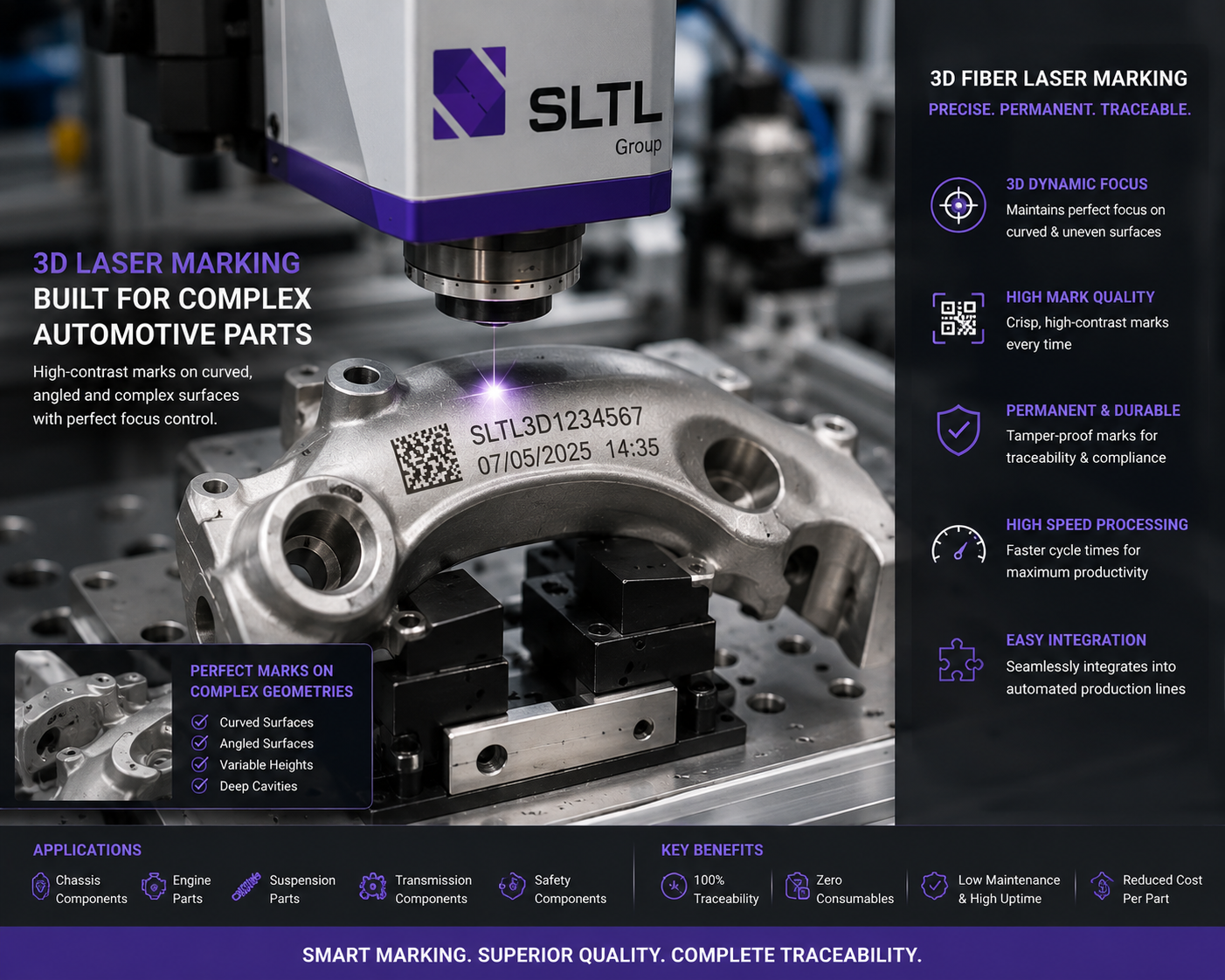
Laser technology covers more than cutting in automotive production. The same production environment that uses laser cutting for chassis brackets may also use laser tube cutting for frame members, laser welding for structural assembly, and laser marking for piston ring identification, 2D/3D DataMatrix traceability codes, and component part numbers.
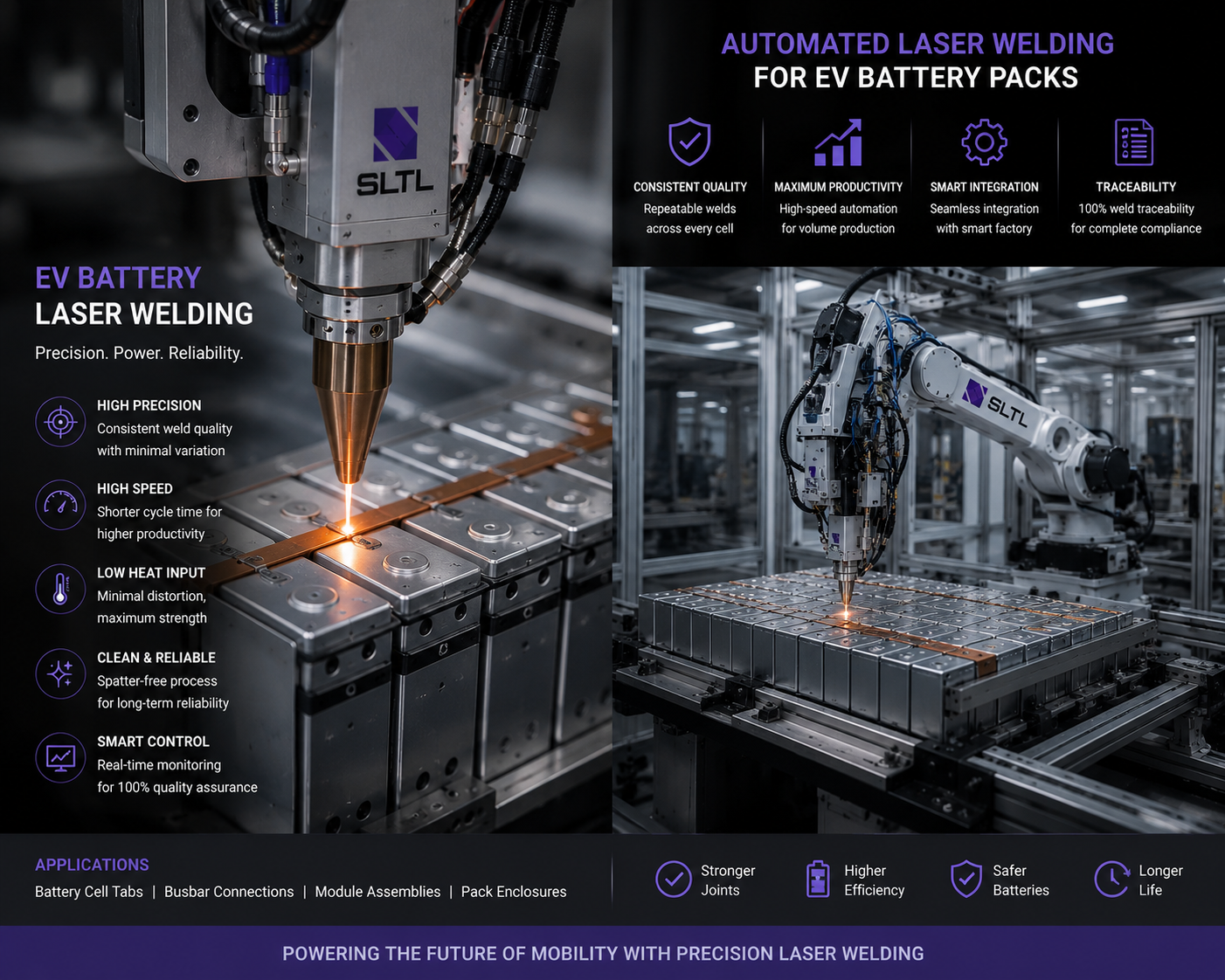
These technologies work together as an integrated system. Laser-cut chassis parts move directly to laser welding — where the accurate edges and minimal HAZ from laser cutting translate into tight weld gaps and high-quality joints. Laser marking then applies the traceability codes that OEM supply chain requirements demand. This is the smart, connected, automated production architecture that Industry 4.0 manufacturing is built on.
For automotive manufacturers also evaluating laser welding for chassis assembly, SLTL’s automotive laser welding systems complement the cutting capability with the same precision advantage at the joining stage.
Reduced Scrap and Material Waste
Laser cutting’s narrow kerf (0.2–0.5 mm) compared to plasma’s wider kerf (1.5–3 mm) reduces the material removed per cut. On closely nested chassis component layouts, this kerf difference affects how many parts fit per sheet — and therefore the material cost per part.
Additionally, laser cutting’s higher dimensional accuracy reduces scrap from out-of-tolerance parts. Plasma-cut parts that fail dimensional inspection because of arc wander or HAZ distortion are a recurring scrap source on tight-tolerance chassis applications. Laser-cut parts at the same tolerances pass inspection consistently.
SLTL Laser Cutting Solutions for Automotive Chassis Production
SLTL Group provides a complete range of laser cutting systems for automotive chassis manufacturing — from entry-level platforms for tier-2 suppliers to advanced high-power systems for volume OEM production.
Future X — Advanced Laser Cutting Machine
The Future X is SLTL’s most advanced laser cutting platform. It brings smart automation features, precise CNC control, and the production capability required for complex chassis geometries and mixed-material production. Furthermore, it gives automotive suppliers a genuine competitive edge — faster changeover, tighter tolerances, and better edge quality than plasma-based alternatives.
For automotive chassis manufacturers evaluating laser as a plasma cutting alternative, the Future X demonstrates what advanced laser cutting actually delivers at production volume. Explore SLTL’s laser cutting machine options for automotive chassis production.
Infinity F1 — High Power Laser Cutting Machine
The Infinity F1 is built for heavy-duty automotive manufacturing. It handles thick structural steel chassis sections — 8 mm to 20 mm — at high production speeds without compromise on edge quality. Moreover, its sustained high-power output delivers the throughput that volume chassis production requires on heavier material thicknesses.
For suppliers cutting thick chassis rails, sub-frame members, and structural reinforcements, the Infinity F1 provides the power and duty cycle that heavy structural steel demands — while maintaining the edge quality advantage over plasma that thinner material applications also benefit from.
IntegreX — Affordable Laser Cutting Machine
The IntegreX makes precision laser chassis cutting accessible for tier-2 and tier-3 automotive suppliers. It processes standard chassis sheet thicknesses efficiently. Furthermore, it delivers genuine production capability — better edge quality, better dimensional accuracy, and eliminated secondary operations — at an acquisition cost that makes the transition from plasma economically practical.
For suppliers currently running plasma cutting for chassis work, the IntegreX provides the direct laser upgrade path at an accessible price point. Discover SLTL’s automotive chassis cutting solutions for your production tier.
X5 — 3D Laser Cutting Machine
The X5 specialises in three-dimensional cutting on complex automotive chassis components. It handles compound surface cutting, hydroformed panel trimming, and structural node geometry that flat-bed systems and plasma cannot accurately process.
Additionally, the X5 supports chassis applications where cutting happens on formed or curved surfaces — replacing hard trim tooling with a flexible, digitally programmed laser cutting process that handles design changes without new tooling investment.
Upgrade Automotive Chassis Production with SLTL Laser Technology
Automotive chassis manufacturers face the same pressure as every other tier of the supply chain — tighter tolerances, faster delivery, more complex geometries, and less room for rework and secondary operations. Plasma cutting has served the industry well, but it cannot meet these demands at the quality level that modern automotive production requires.
SLTL’s laser cutting, welding, and marking solutions address chassis manufacturing requirements across every production step.
What SLTL laser cutting delivers for automotive chassis production:
- Better edge quality — smooth, perpendicular cut edges with minimal HAZ and near-zero dross
- Reduced rework — laser-cut parts go directly to welding without grinding or deburring
- Faster production — higher cut speeds on thin-to-medium chassis sheet with no consumable changes
- Smart automation — CNC programme control, sub-minute changeover, MES integration
- Precision manufacturing — ±0.05–0.1 mm dimensional accuracy on chassis profiles
- Reduced wastage — narrow kerf and better yield versus plasma on nested layouts
- Industry 4.0 readiness — digital-native systems compatible with connected production environments
Contact SLTL today to discuss your chassis cutting application, request a sample cut on your specific material and thickness, or compare laser and plasma performance directly on your production geometry.
Conclusion
The laser cutting vs plasma cutting automotive comparison is not a close contest on most chassis manufacturing criteria. Laser cutting delivers better edge quality, tighter dimensional accuracy, smaller HAZ, lower rework rates, and better automation compatibility across the material thicknesses that automotive chassis production uses most.
Plasma cutting remains a viable option for very thick structural steel at high volume where edge quality and dimensional accuracy requirements are less demanding. However, for modern automotive chassis components — increasingly made from thin-gauge AHSS, complex geometries, and tight assembly tolerances — laser cutting is the right technology.
Furthermore, laser cutting integrates into a complete production system alongside laser welding and laser marking. Together, these technologies deliver the precision, traceability, and throughput that OEM supply chain requirements now demand from every tier of automotive production. SLTL’s laser solutions are built to support that complete production architecture.
Frequently Asked Questions
Q1: Is laser cutting faster than plasma cutting for automotive chassis parts?
On thin-to-medium chassis sheet (1–6 mm), fibre laser cutting runs faster than plasma cutting at equivalent or better edge quality. On thicker structural sections (12 mm+), plasma cutting can maintain speed parity but at significantly lower edge quality. Furthermore, laser cutting eliminates the secondary deburring and grinding steps that plasma-cut parts typically require — multiplying the total production time advantage when the full process chain is compared.
Q2: What is the heat-affected zone difference between laser and plasma cutting on automotive steel?
Plasma cutting produces an HAZ typically 3–8 mm wide on standard automotive chassis steel. Laser cutting produces an HAZ typically 0.1–0.5 mm wide on the same material. For high-strength steel chassis components where material properties in the HAZ affect structural performance, this difference is significant. Laser cutting preserves the base material’s designed mechanical properties right up to the cut edge.
Q3: Can laser cutting replace plasma cutting completely in automotive chassis manufacturing?
For most automotive chassis applications — thin-to-medium gauge sheet, structural brackets, and components requiring tight tolerances — laser cutting is the superior replacement for plasma. On very thick structural sections (20 mm+) in high-volume basic profiling applications, plasma may retain speed advantages. However, the edge quality, accuracy, and automation benefits of laser make it the preferred technology for most modern chassis production environments.
Q4: What maintenance does a laser cutting machine require compared to plasma?
Plasma cutting systems require frequent consumable replacement — electrodes and nozzles typically need changing every 2–8 hours of cutting, depending on material and current settings. Laser cutting systems require periodic inspection and replacement of nozzles and protective lenses, with service intervals typically measured in hundreds of operating hours. Consequently, laser cutting has significantly lower maintenance frequency and consumable cost than plasma for comparable production volume.
Q5: What is the return on investment timeline for switching from plasma to laser cutting in chassis production?
Most automotive chassis manufacturers running medium-to-high volume production see full payback on laser cutting capital investment within 18–30 months when transitioning from plasma. Key savings come from eliminated secondary operations (deburring, grinding), lower consumable costs, reduced scrap from out-of-tolerance parts, and faster cycle times on thin-gauge material. The ROI calculation improves further when quality-related costs — rework, fixture adjustment, weld quality issues — are included.