The global EV market is growing at a rapid pace. Automakers and suppliers need faster, cleaner, and more precise joining technologies. That is why the demand for a laser welding machine for EV parts has surged across the industry. Modern EV component welding requires accuracy that traditional methods cannot deliver. At the same time, automotive welding standards continue to rise — driven by lightweight design, structural safety, and smart manufacturing requirements.
Laser welding technology addresses all of these challenges simultaneously. It delivers high-strength weld joints, minimal distortion, and consistent quality — batch after batch. Additionally, it integrates smoothly into automated production lines and Industry 4.0 environments.
Conventional welding processes involve high heat input, slower speeds, and more material waste. As a result, manufacturers face higher production costs and inconsistent weld quality. Laser welding eliminates many of these problems. It uses a precisely focused beam to fuse metal surfaces with minimal heat spread.
Moreover, as EV battery packs, chassis assemblies, and structural components require tighter tolerances, laser welding has become a non-negotiable technology. This blog helps EV manufacturers, automotive OEM suppliers, and fabrication companies understand how laser welding works — and how to choose the right system for their production needs.
SLTL Group manufactures advanced laser welding systems designed specifically for industrial and automotive applications. The Nova, ENZO, and Hertz product lines cover a wide range of production requirements — from precision component welding to flexible workshop operations.
Why a Laser Welding Machine for EV Parts Matters in Manufacturing
EV production depends on precision. Battery modules, cooling plates, motor housings, and structural enclosures all require clean, accurate weld joints. A laser welding machine for EV parts delivers exactly this — with speed and consistency that conventional welding cannot match.
Precision Welding for EV Battery Components
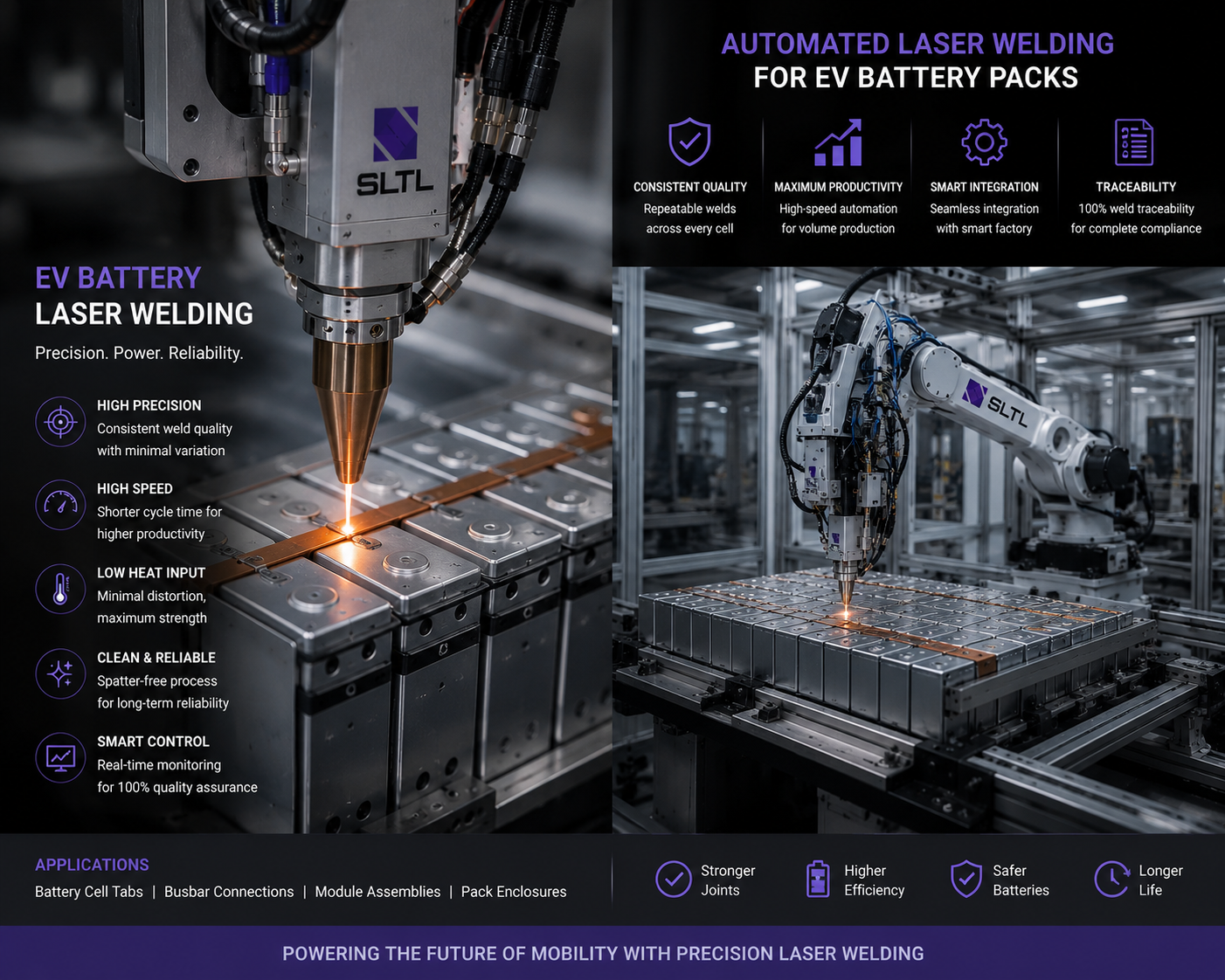
EV battery packs contain hundreds of individual cells. These cells are connected through thin copper or aluminum busbars. Welding these connections requires extreme precision. Too much heat can damage the cell chemistry or cause micro-cracks.
Laser welding applies a focused, controlled beam. It melts only the target zone. As a result, the surrounding material stays cool and undamaged. This precision makes laser welding the preferred choice for battery cell joining.
Low Distortion Welding for Automotive Assemblies
Automotive structural components must fit with tight dimensional tolerances. Distortion from conventional welding causes misalignment. It also increases secondary finishing work.
Laser welding reduces the heat-affected zone significantly. Therefore, distortion is minimal. Parts retain their original shape after welding. This improves assembly accuracy and reduces rework.
- Higher structural weld strength across all materials
- Consistent bead geometry across long production runs
- Reduced spatter and cleaner weld surface finish
- Faster cycle times with no compromise on weld quality
- Seamless integration with robotic and CNC-controlled systems
Furthermore, laser welding supports faster production workflows. A single laser welding station can replace multiple conventional welding setups. This reduces floor space requirements and lowers operational complexity.
Key Features to Look for in an EV Component Welding Machine
Selecting the right laser welding machine requires a clear understanding of your production requirements. Not all systems are built the same. However, certain core features define high-performance EV component welding machines.
Laser Power and Welding Speed
Power output determines the materials and thicknesses a machine can process. EV battery welding typically requires 200–500W. Structural welding may need higher power outputs. Always match the power range to your application.
Welding speed directly affects production throughput. Higher speed means shorter cycle times. Consequently, overall manufacturing output increases without adding more equipment.
Precision Beam Control and Smart Software
Advanced beam shaping and positioning controls allow for complex weld paths. This is essential for battery cell connections and intricate automotive sub-assemblies.
Smart software integration enables real-time weld monitoring. Operators can set process parameters, track weld quality, and flag deviations automatically. Additionally, data-logging capabilities support traceability and quality audits.
Automation Compatibility and Safety
Modern laser welding machines must work with robotic arms, conveyor systems, and CNC platforms. This allows seamless integration into automated production lines.
Safety features such as enclosed beam paths, interlock systems, and fume extraction are equally important. They protect operators and maintain compliance with industrial safety standards.
- Variable laser power selection (200W to 2000W+ depending on application)
- High-speed galvo scanning for complex weld patterns
- Integrated cooling systems for continuous industrial operation
- Weld seam monitoring with vision-based quality detection
- PLC and SCADA system compatibility for smart factory integration
- Compact footprint for space-optimized production layouts
How Laser Welding Improves Automotive Manufacturing Efficiency
Automotive manufacturers face constant pressure to reduce costs and improve output. Laser welding delivers measurable improvements across every stage of the production process.
High-Strength Welding for Lightweight Structures
Lightweight vehicle design is a central goal for EV manufacturers. Materials such as aluminum, high-strength steel, and advanced alloys are now standard in EV chassis and body panels.
Laser welding creates deep-penetration welds with minimal material distortion. As a result, weld joints are stronger without adding extra material weight. This directly supports lightweight structure manufacturing.
Compatible materials for automotive laser welding:
- Mild steel — structural frames, body panels, seat components
- Stainless steel — exhaust systems, battery enclosures, fuel cells
- Aluminum — battery trays, door panels, chassis crossmembers
- High-strength automotive alloys — safety-critical structural parts
Clean Welding for Precision Automotive Components
Conventional welding produces spatter, oxidation, and rough surface finishes. These require additional grinding, polishing, and quality inspection. Therefore, overall production time increases.
Laser welding produces clean, smooth welds with minimal surface contamination. Secondary finishing is reduced significantly. Consequently, cycle times improve and operational costs decrease.
As automotive manufacturers transition from conventional processing to laser-based systems, the shift extends beyond welding alone. Laser cutting is also transforming how automotive parts are fabricated. For context on this broader industrial shift, see our related article: Why Automotive Part Makers Are Moving from Conventional Cutting to Laser Cutting.
Key application areas for automotive laser welding:
- EV battery trays and module housings
- Automotive chassis and frame assemblies
- Structural cross-members and supports
- Thin-sheet body panels and closures
- EV motor housings and power electronics enclosures
- Precision sub-assemblies for OEM suppliers
Best SLTL Laser Welding Machines for EV and Automotive Production
SLTL Group designs industrial laser systems for high-demand manufacturing environments. Their laser welding machine product range includes models built for EV production, automotive structural fabrication, and flexible workshop applications. Each system is engineered for reliability, precision, and smart manufacturing integration.
Nova — High-Performance Laser Welding System (200–500W)
The Nova is a fully customized laser welding machine for EV parts and industrial manufacturing applications requiring high output and consistent performance.
- Power range: 200–500W, scalable to application requirements
- High-precision beam delivery for complex automotive weld profiles
- Smart automation compatibility with robotic and CNC systems
- Designed for continuous high-volume industrial production
Ideal Nova applications:
- EV battery module and busbar welding
- Automotive structural frame and chassis fabrication
- Precision joining for powertrain and drivetrain components
- High-volume OEM supplier production workflows
Learn more about the Nova system: Nova Laser Welding Machine — SLTL Group
ENZO — Precision Laser Welding Machine (Up to 200W)
The ENZO is designed for fine-detail welding applications where precision is the top priority. It delivers clean, accurate welds on thin materials and complex geometries.
- Laser power: up to 200W for controlled fine-detail welding
- Exceptional beam accuracy for micro-welding and small component joining
- Compact industrial design for optimized floor space use
- Suitable for light-gauge materials and precision sub-assemblies
Ideal ENZO applications:
- Thin-sheet automotive body panels and closures
- Precision sensor housings and electronics enclosures
- Lightweight EV structural components
- Fine-detail sub-assembly fabrication for automotive OEMs
Explore the ENZO system: ENZO Precision Laser Welding Machine — SLTL Group
Hertz — Handheld Laser Welding Machine
The Hertz is a portable, handheld laser welding solution built for flexible manufacturing environments. It brings laser-quality welding to repair operations and small-batch production workflows.
- Handheld operation for maximum flexibility and maneuverability
- Portable design supports mobile workshop and field welding use
- Delivers consistent weld quality without fixed positioning constraints
- Ideal for repair welding, maintenance, and short-run production
Ideal Hertz applications:
- Automotive component repair and maintenance welding
- Flexible fabrication in smart workshop environments
- Small-batch and prototype production runs
- On-site weld repair for large automotive sub-assemblies
View the Hertz handheld welding system: Hertz Handheld Laser Welding Machine — SLTL Group
Smart Manufacturing Benefits of Automotive Laser Welding
Industry 4.0 is reshaping automotive manufacturing. Smart factories depend on connected, data-driven production systems. Laser welding integrates naturally into these environments.
Smart Automation in EV Manufacturing
Laser welding machines can be programmed for complex weld sequences. They work with robotic arms and automated material handling systems. As a result, production lines run with minimal human intervention.
Real-time weld monitoring sensors detect deviations during the process. Alerts are generated instantly. Therefore, defective welds are flagged before they move to the next production stage.
- Full integration with PLC, SCADA, and MES systems
- Remote monitoring and production data logging for audit trails
- Predictive maintenance alerts to reduce unplanned downtime
- Scalable automation modules for growing production demands
- Compatible with Industry 4.0 smart factory architectures
Furthermore, laser welding reduces changeover times. Modern systems allow rapid parameter adjustments between different component types. This improves production flexibility without sacrificing throughput.
For manufacturers investing in broader smart fabrication capabilities, SLTL’s automotive laser cutting solutions complement welding workflows by providing precise material preparation ahead of assembly operations.
Applications of Laser Welding in EV and Automotive Manufacturing
Modern automotive production relies on a range of laser technologies working together. Laser welding, cutting, and marking each play a distinct role — and their combination creates a complete smart fabrication ecosystem.
Core Laser Welding Applications
- EV battery cell and module welding — copper/aluminum busbar joining
- Automotive structural fabrication — chassis frames, roll cages, floor pans
- Precision sheet metal joining — door inners, hood liners, pillar assemblies
- Lightweight chassis fabrication — high-strength steel and aluminum structures
- Smart production workflows — fully automated, vision-guided weld cells
- High-strength component manufacturing — safety-critical structural parts
Integration with Laser Cutting and Marking Technologies
Automotive production is not limited to welding alone. Laser cutting prepares components with precision before they are welded. For example, tube cutting and 2D/3D profile cutting ensure parts arrive at the welding station with clean, accurate edges.
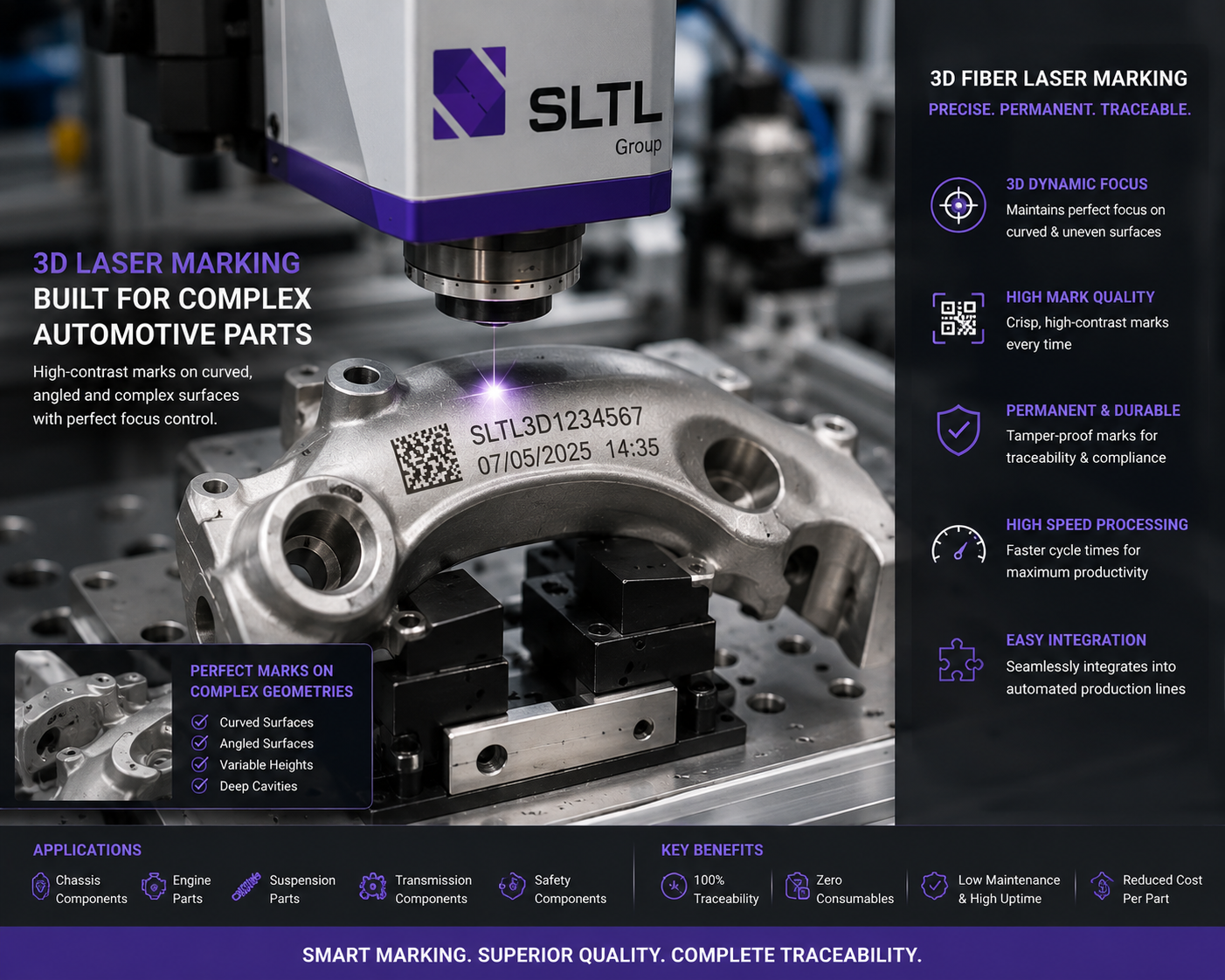
Laser marking adds traceability to every part. Piston ring marking, chassis marking, and 2D/3D job marking allow manufacturers to track components across the production and quality inspection lifecycle. Airbag and composite material cutting also relies on laser precision to maintain structural integrity.
Together, these three technologies — cutting, welding, and marking — create a seamless, automated production chain. Manufacturers gain higher throughput, lower scrap rates, and complete part traceability from raw material to final assembly.
Upgrade Your Production with SLTL Laser Technology
Ready to modernize your EV or automotive manufacturing line?
SLTL Group offers a complete range of laser welding, cutting, and marking solutions for EV and automotive manufacturers. Whether you need a precision laser welding machine for EV parts production, high-speed automotive cutting, or smart factory marking systems — SLTL has the right solution.
Why choose SLTL laser technology?
- Cleaner weld quality with minimal spatter and distortion
- Reduced operational costs through faster cycle times
- Smart manufacturing integration — Industry 4.0 ready
- Precision EV fabrication across batteries, chassis, and enclosures
- Complete laser ecosystem — cutting, welding, and marking
- Proven performance across automotive OEM and Tier-1 supplier environments
Contact SLTL Group today to discuss your production requirements and discover the right laser welding system for your manufacturing line.
Explore our full range: SLTL Laser Welding Machines | SLTL Laser Cutting Machines | SLTL Laser Marking Machines
Conclusion
The shift to electric vehicles has fundamentally changed manufacturing requirements. Precision, speed, and smart automation are now the baseline — not a competitive advantage. A laser welding machine for EV parts addresses all of these demands directly.
Laser welding delivers stronger joints, lower distortion, and faster production cycles compared to conventional processes. Moreover, it integrates naturally into smart factory environments — supporting data-driven quality control, automated workflows, and scalable production planning.
SLTL’s Nova, ENZO, and Hertz laser welding systems give EV manufacturers and automotive OEM suppliers the tools they need to meet modern production standards. Combined with SLTL’s laser cutting and marking technologies, manufacturers gain a complete, integrated fabrication ecosystem.
For EV and automotive manufacturers looking to improve weld quality, reduce costs, and scale smart production — the right laser welding machine is the foundation of that future.
Frequently Asked Questions (FAQs)
1. What materials can a laser welding machine for EV parts process?
Laser welding machines can process mild steel, stainless steel, aluminum, copper, and high-strength automotive alloys. These materials cover the full range of EV battery, chassis, and structural component applications.
2. How fast is laser welding compared to conventional automotive welding?
Laser welding is typically 3–10 times faster than MIG or TIG welding for comparable joint configurations. Higher speed reduces cycle times, improves throughput, and lowers production costs significantly.
3. Can a laser welding machine be integrated into an automated EV production line?
Yes. Modern laser welding machines are designed for full automation compatibility. They work with robotic arms, CNC systems, PLC controllers, and SCADA platforms. Additionally, real-time weld monitoring supports closed-loop quality control in smart factory environments.
4. How does laser welding minimize distortion in EV battery components?
Laser welding uses a focused, high-intensity beam with a very small spot size. This concentrates heat precisely on the weld zone. As a result, the heat-affected zone remains minimal. Surrounding material is not significantly heated, which prevents thermal distortion of delicate EV battery components.
5. Which SLTL laser welding machine is best for high-volume EV production?
The SLTL Nova (200–500W) is the recommended choice for high-volume EV manufacturing. It delivers consistent performance, smart automation compatibility, and supports complex weld profiles required for battery modules, structural assemblies, and precision automotive components.